
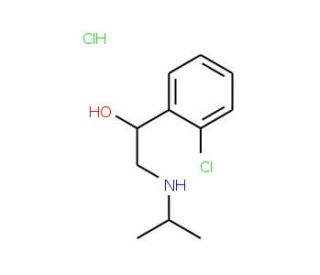

Clorprenaline Hydrochloride (CAS 6933-90-0)
QUICK LINKS
Clorprenaline Hydrochloride is an organic compound of interest in the field of biochemical research for its adrenergic agonist properties. In academic settings, it is frequently used to study the biochemical pathways and mechanisms involving beta-adrenergic receptors. Researchers leverage this compound to explore the intricacies of intracellular signaling cascades that are triggered by the activation of these receptors. Clorprenaline Hydrochloride also serves as a reference compound in analytical studies aiming to develop new detection methods for substances with similar structures or activities. In a broader context, this compound helps in the examination of the receptor-ligand interactions and contributes to the field of molecular biology by providing insight into the design of receptor-specific probes or antagonists.
Clorprenaline Hydrochloride (CAS 6933-90-0) References
- Effect of dihydroergotoxine on activities of beta-receptor stimulators. | Kitamura, S., et al. 1977. Arzneimittelforschung. 27: 1959-61. PMID: 21668
- Simultaneous detection of residues of 25 β₂-agonists and 23 β-blockers in animal foods by high-performance liquid chromatography coupled with linear ion trap mass spectrometry. | Sai, F., et al. 2012. J Agric Food Chem. 60: 1898-905. PMID: 22329604
- Simultaneous and confirmative detection of multi-residues of β₂-agonists and β-blockers in urine using LC-MS/MS/MS coupled with β-receptor molecular imprinted polymer SPE clean-up. | Fan, S., et al. 2013. Food Addit Contam Part A Chem Anal Control Expo Risk Assess. 30: 2093-101. PMID: 24138591
- Preparation of Fe2O3-Clorprenaline/Tetraphenylborate Nanospheres and Their Application as Ion Selective Electrode for Determination of Clorprenaline in Pork. | Shao, X., et al. 2016. Nanoscale Res Lett. 11: 178. PMID: 27044307
- Enantiomeric separation of seven β-agonists by NACE-Study of chiral selectivity with diacetone-d-mannitol-boric acid complex. | Lv, L., et al. 2017. J Pharm Biomed Anal. 145: 399-405. PMID: 28719814
- A novel one-pot strategy to prepare β-cyclodextrin functionalized capillary monoliths for enantioseparation of basic drugs. | Deng, M., et al. 2018. Talanta. 189: 458-466. PMID: 30086947
- Molecular, morphological and behavioral alterations of zebrafish (Danio rerio) embryos/larvae after clorprenaline hydrochloride exposure. | Wang, B., et al. 2023. Food Chem Toxicol. 176: 113776. PMID: 37059383
- Effects of 1-(2-chloro-4-hydroxyphenyl)-t-butylaminoethanol (HOKU-81), a new bronchodilator, on isolated trachea and atria of guinea pig. | Gomi, Y., et al. 1979. Jpn J Pharmacol. 29: 515-24. PMID: 537270
- Synthesis and characterization of drug–saccharide conjugates by enzymatic strategy in organic media | Quan, J., Xu, J. M., Liu, B. K., Zheng, C. Z., & Lin, X. F. 2007. Enzyme and microbial technology. 41(6-7): 756-763.
- Determination of Salbutamol, Clenbuterol, and Brombuterol in Urine by a Highly Sensitive Chemiluminescence Enzyme Immunoassay | Wu, Y., Xu, F., Jiang, H., Tao, X., Zhu, K., Liu, W.,.. & Ding, S. 2014. Analytical Letters. 47(16): 2761-2773.
- First report on clorprenaline HCl degradation products: identification and characterization by LC–MS/MS | Prajapati, K. J., & Kothari, C. S. 2020. Journal of the Iranian Chemical Society. 17(5): 1027–1039.
Ordering Information
| Product Name | Catalog # | UNIT | Price | Qty | FAVORITES | |
Clorprenaline Hydrochloride, 1 g | sc-337639 | 1 g | $105.00 |