
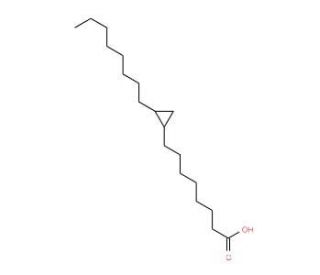

cis-9,10-Methyleneoctadecanoic Acid (CAS 4675-61-0)
See product citations (2)
QUICK LINKS
cis-9,10-Methyleneoctadecanoic Acid is a specialized fatty acid with a unique methylene-interrupted double bond configuration. This compound is of particular interest in the study of lipid biochemistry and the investigation of fatty acid metabolism. Research involving cis-9,10-Methyleneoctadecanoic Acid often centers on its incorporation into cellular membranes and the resulting effects on membrane fluidity, permeability, and function. The compound′s distinct structure allows for the exploration of its role in the biosynthesis of complex lipids and the impact it has on the physical properties of lipids and lipid-derived materials. Additionally, cis-9,10-Methyleneoctadecanoic Acid is used in the study of lipid-derived signaling molecules and their pathways, contributing to the understanding of how structural variations among fatty acids can influence signaling mechanisms within cells. It also serves as useful for researchers developing lipid-based industrial products, where modifications to fatty acid composition can lead to materials with specific desirable characteristics.
cis-9,10-Methyleneoctadecanoic Acid (CAS 4675-61-0) References
- [Application of gas chromatography in the identification of Enterobacter cloacae, Enterobacter aerogenes, and Enterobacter agglomerans]. | Robles Valderrama, E., et al. 1999. Rev Latinoam Microbiol. 41: 11-6. PMID: 10932747
- Helicobacter pylori augments the acid inhibitory effect of omeprazole on parietal cells and gastric H(+)/K(+)-ATPase. | Beil, W., et al. 2001. Gut. 48: 157-62. PMID: 11156634
- Effects of thiastearic acids on growth and on dihydrosterculic acid and other phospholipid fatty acyl groups of Leishmania promastigotes. | Beach, DH., et al. 1989. Mol Biochem Parasitol. 35: 57-66. PMID: 2761573
- Raman spectroscopy as a tool for tracking cyclopropane fatty acids in genetically engineered Saccharomyces cerevisiae. | Kochan, K., et al. 2019. Analyst. 144: 901-912. PMID: 30207333
- A model for the prediction of antimicrobial resistance in Escherichia coli based on a comparative evaluation of fatty acid profiles. | Stahl, RS., et al. 2020. Diagn Microbiol Infect Dis. 96: 114966. PMID: 31948696
- Unusual cellular fatty acids and distinctive ultrastructure in a new spiral bacterium (Campylobacter pyloridis) from the human gastric mucosa. | Goodwin, CS., et al. 1985. J Med Microbiol. 19: 257-67. PMID: 3981612
- Occurrence of cis-9,10-methylenehexadecanoic and cis-9, 10-methyleneoctadecanoic acids in the lipids of immature and mature Fundulus heteroclitus (L.), and in roe. | Cosper, CI. and Ackman, RG. 1983. Comp Biochem Physiol B. 75: 649-54. PMID: 6617160
- Interaction of Helicobacter pylori and its fatty acids with parietal cells and gastric H+/K(+)-ATPase. | Beil, W., et al. 1994. Gut. 35: 1176-80. PMID: 7959221
- The Helicobacter pylori fatty acid cis-9,10-methyleneoctadecanoic acid stimulates protein kinase C and increases DNA synthesis of gastric HM02 cells. | Beil, W., et al. 1998. Br J Cancer. 77: 1852-6. PMID: 9667658
- Helicobacter pylori fatty acid cis 9,10-methyleneoctadecanoic acid increases [Ca2+]i, activates protein kinase C and stimulates acid secretion in parietal cells. | Beil, W., et al. 1998. Prostaglandins Leukot Essent Fatty Acids. 59: 119-25. PMID: 9774175
Ordering Information
| Product Name | Catalog # | UNIT | Price | Qty | FAVORITES | |
cis-9,10-Methyleneoctadecanoic Acid, 25 mg | sc-280644 | 25 mg | $485.00 |