
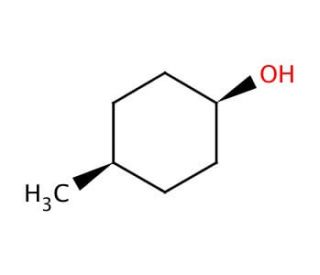

cis-4-Methylcyclohexanol (CAS 7731-28-4)
QUICK LINKS
cis-4-Methylcyclohexanol stands as a cyclic alcohol widely utilized as an intermediate compound within the chemical industry. This colorless liquid possesses a pleasant fruity scent and finds its application in the production of diverse products, encompassing plasticizers, solvents, lubricants, and fragrances. Scientific research has extensively examined the potential applications of cis-4-Methylcyclohexanol. It has been employed as a substrate in enzyme assays and as a model compound for investigating enzyme-catalyzed reactions. Additionally, it has served as an inhibitor of enzymes. Researchers have utilized it to explore the mechanism of action of enzymes and examine the impact of environmental pollutants on enzyme activity. Notably, cis-4-Methylcyclohexanol has demonstrated inhibitory properties against enzymes, including cytochrome P450 enzymes. By binding to the enzyme′s active site, it obstructs the substrate from binding, consequently impeding the enzyme′s activity. Furthermore, studies have indicated its interaction with other proteins, such as the transcription factor NF-κB, a regulator of gene expression involved in inflammation and immunity.
cis-4-Methylcyclohexanol (CAS 7731-28-4) References
- STEREOCHEMICAL ASPECTS OF THE METABOLISM OF THE ISOMERIC METHYLCYCLOHEXANOLS AND METHYLCYCLOHEXANONES. | ELLIOTT, TH., et al. 1965. Biochem J. 95: 59-69. PMID: 14333568
- THE METABOLISM OF METHYLCYCLOHEXANE. | ELLIOTT, TH., et al. 1965. Biochem J. 95: 70-6. PMID: 14333569
- Laser-induced fluorescence spectra of 4-methylcyclohexoxy radical and perdeuterated cyclohexoxy radical and direct kinetic studies of their reactions with O2. | Zhang, L., et al. 2005. J Phys Chem A. 109: 9232-40. PMID: 16833263
- Stereoretentive chlorination of cyclic alcohols catalyzed by titanium(IV) tetrachloride: evidence for a front side attack mechanism. | Mondal, D., et al. 2013. J Org Chem. 78: 2118-27. PMID: 23298402
- Redox chain reaction-indole and pyrrole alkylation with unactivated secondary alcohols. | Han, X. and Wu, J. 2013. Angew Chem Int Ed Engl. 52: 4637-40. PMID: 23554147
- Evaluating Force Field Performance in Thermodynamic Calculations of Cyclodextrin Host-Guest Binding: Water Models, Partial Charges, and Host Force Field Parameters. | Henriksen, NM. and Gilson, MK. 2017. J Chem Theory Comput. 13: 4253-4269. PMID: 28696692
- Binding Thermodynamics of Host-Guest Systems with SMIRNOFF99Frosst 1.0.5 from the Open Force Field Initiative. | Slochower, DR., et al. 2019. J Chem Theory Comput. 15: 6225-6242. PMID: 31603667
- trans-Selective and Switchable Arene Hydrogenation of Phenol Derivatives. | Wollenburg, M., et al. 2020. ACS Catal. 10: 11365-11370. PMID: 33133752
- Amine Organocatalysis of Remote, Chemoselective C(sp3)-H Hydroxylation. | Hahn, PL., et al. 2022. ACS Catal. 12: 4302-4309. PMID: 35529672
- Simple Method for the Conversion of Light Cracked Naphtha into Efficient Lubricity Improvers for Ultra-Low Sulfur Diesel. | Huligujje, S., et al. 2022. ACS Omega. 7: 27969-27979. PMID: 35990473
- Conditioned behavior in Drosophila melanogaster. | Quinn, WG., et al. 1974. Proc Natl Acad Sci U S A. 71: 708-12. PMID: 4207071
Ordering Information
| Product Name | Catalog # | UNIT | Price | Qty | FAVORITES | |
cis-4-Methylcyclohexanol, 5 g | sc-278855 | 5 g | $145.00 |