
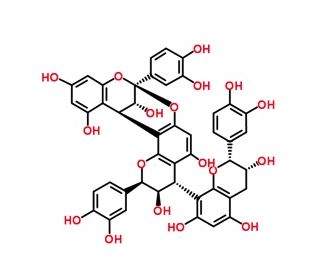

Cinnamtannin B-1 (CAS 88082-60-4)
QUICK LINKS
Cinnamtannin B-1 is a proanthocyanidin, a type of condensed tannin, derived from various plant sources, notably cinnamon. This polyphenolic compound has garnered significant interest in scientific research due to its complex structure and potential biological activities. The mechanism of action of cinnamtannin B-1 involves its ability to interact with proteins and cell membranes, leading to various biochemical effects. It is known to exhibit strong antioxidant properties by scavenging free radicals and inhibiting oxidative stress. Additionally, cinnamtannin B-1 can interfere with the signaling pathways of enzymes involved in inflammation and cellular proliferation. In research, cinnamtannin B-1 is utilized to explore its effects on cellular oxidative stress and its role in mitigating oxidative damage. Researchers study its interaction with key enzymes and signaling molecules to understand its potential in modulating biochemical pathways. It is also used to investigate the compound′s ability to inhibit the aggregation of proteins, which is relevant in studies of neurodegenerative diseases. Furthermore, cinnamtannin B-1 is employed in studies examining its antimicrobial properties, where it is tested against various bacterial and fungal strains to understand its mechanism of microbial inhibition. Its role in biofilm disruption and inhibition is another area of significant research, as biofilms are a major concern in both medical and industrial settings. The compound′s impact on cell signaling pathways, antioxidant defenses, and microbial interactions highlights its diverse applications in scientific research, contributing to our understanding of natural polyphenolic compounds and their potential utility in various biological contexts.
Cinnamtannin B-1 (CAS 88082-60-4) References
1. Ezaki, N., et al. 1985. Planta Med. 51: 34-38. PMID: 173403962. Kashiwada,Y., et al. 1992. J. Nat. Prod. 55: 1033-1043. PMID: 1431932
3. Ho, K.Y., et al. 1999 J. Pharm. Pharmacol. 51: 1075-1078. PMID: 10528992
4. Kamiya, K., et al. 2001. Chem. Pharm. Bull. 49: 551-557. PMID: 11383605
5. Taher, M., et al .2004. Med. J. Malaysia. 59: 97-98. PMID: 15468836
6. Jayaprakasha, G.K., et al. 2006. J. Agric. Food Chem. 54: 1672-1679. PMID: 16506818
7. Ben Amor, N., et al. 2007. J. Med. Chem. 50: 3937-3944. PMID: 17602466
8. Bouaziz, A., et al. 2007. Apoptosis. 12: 489-498. PMID: 17195094
9. Bouaziz, A., et al. 2007. Arch. Biochem. Biophys. 457: 235-242. PMID: 17118329
10. López, J.J., et al. 2008. Life Sci. 82: 977-982. PMID: 18433795
Ordering Information
| Product Name | Catalog # | UNIT | Price | Qty | FAVORITES | |
Cinnamtannin B-1, 5 mg | sc-202997 | 5 mg | $237.00 |