
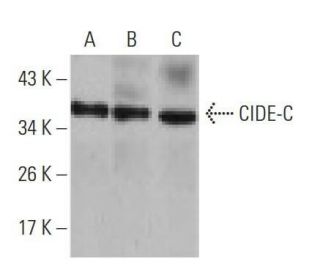


CIDE-C Antibody (7C12F11): sc-517232
- CIDE-C Antibody (7C12F11) is a mouse monoclonal IgG1 CIDE-C antibody provided at 50 µg/0.5 ml
- raised against a recombinant protein corresponding to amino acids 53-141 of CIDE-C of human origin
- recommended for detection of CIDE-C of human origin by WB, IP, IF, FCM and ELISA
- At present, we have not yet completed the identification of the preferred secondary detection reagent(s) for CIDE-C Antibody (7C12F11). This work is in progress.

CIDE-C Antibody (7C12F11) is a mouse monoclonal IgG1 antibody that detects CIDE-C protein of human origin by western blotting (WB), immunoprecipitation (IP), immunofluorescence (IF), flow cytometry (FCM), and enzyme-linked immunosorbent assay (ELISA). Anti-CIDE-C antibody (7C12F11) is available as a non-conjugated format. CIDE-C protein, also known as cell death-inducing DFFA-like effector-c, CIDE-3, or Fsp27, is a 238 amino acid protein that plays a crucial role in regulating apoptosis and lipid metabolism. CIDE-C protein is predominantly expressed in the small intestine, colon, heart, and stomach, with lower levels found in the liver, brain, and kidney. CIDE-C protein is localized in the cytoplasm and contains a CIDE-N domain, which is essential for promoting programmed cell death. Notably, CIDE-C exists as three alternatively spliced isoforms, two of which are implicated in the induction of apoptosis, highlighting its importance in cellular homeostasis and response to stress. CIDE-C protein is upregulated during adipogenesis in both white and brown adipose tissues, suggesting a role in negatively regulating lipolysis and promoting triglyceride accumulation, which is significant for understanding metabolic disorders. CIDE-C gene is located on human chromosome 3, a region that encompasses over 1,100 genes, including those associated with various cancers and a chemokine receptor gene cluster, underscoring potential implications in both metabolic and oncogenic pathways.
Alexa Fluor® is a trademark of Molecular Probes Inc., OR., USA
LI-COR® and Odyssey® are registered trademarks of LI-COR Biosciences
CIDE-C Antibody (7C12F11) References:
- Molecular cloning and characterization of CIDE-3, a novel member of the cell-death-inducing DNA-fragmentation-factor (DFF45)-like effector family. | Liang, L., et al. 2003. Biochem J. 370: 195-203. PMID: 12429024
- Fat-specific protein 27, a novel lipid droplet protein that enhances triglyceride storage. | Puri, V., et al. 2007. J Biol Chem. 282: 34213-8. PMID: 17884815
- Fat-specific protein 27 regulates storage of triacylglycerol. | Keller, P., et al. 2008. J Biol Chem. 283: 14355-65. PMID: 18334488
- Hepatic steatosis in leptin-deficient mice is promoted by the PPARgamma target gene Fsp27. | Matsusue, K., et al. 2008. Cell Metab. 7: 302-11. PMID: 18396136
- Cidea is associated with lipid droplets and insulin sensitivity in humans. | Puri, V., et al. 2008. Proc Natl Acad Sci U S A. 105: 7833-8. PMID: 18509062
- Redistribution of cell death-inducing DNA fragmentation factor-like effector-a (CIDEa) from mitochondria to nucleus is associated with apoptosis in HeLa cells. | Valousková, E., et al. 2008. Gen Physiol Biophys. 27: 92-100. PMID: 18645223
- Cell death-inducing DFF45-like effector C is reduced by caloric restriction and regulates adipocyte lipid metabolism. | Magnusson, B., et al. 2008. Metabolism. 57: 1307-13. PMID: 18702959
- Evidence for an important role of CIDEA in human cancer cachexia. | Laurencikiene, J., et al. 2008. Cancer Res. 68: 9247-54. PMID: 19010897
Ordering Information
| Product Name | Catalog # | UNIT | Price | Qty | FAVORITES | |
CIDE-C Antibody (7C12F11) | sc-517232 | 50 µg/0.5 ml | $322.00 |