
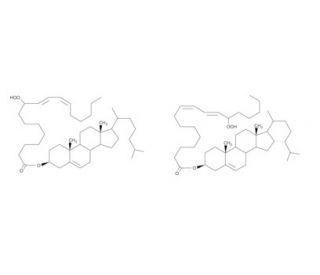

Cholesteryl Linoleate Hydroperoxides
QUICK LINKS
Cholesteryl linoleate hydroperoxides represent a class of lipid peroxidation products formed when cholesteryl linoleate, an ester of cholesterol and linoleic acid, undergoes oxidation. These compounds are crucial in studies investigating the mechanisms behind lipid peroxidation and its subsequent impact on cellular structures, particularly within the context of lipid membranes and lipoproteins. The formation of cholesteryl linoleate hydroperoxides typically involves the abstraction of hydrogen atoms from linoleic acid residues, leading to the formation of hydroperoxide groups. This modification significantly alters the physical and chemical properties of the lipid, including its polarity and stability. In research settings, these hydroperoxides have been used to explore oxidative stress pathways, which are fundamental to understanding the degradation processes in cellular membranes that contribute to the alteration of cellular integrity and function. By examining how these hydroperoxides affect lipid bilayers and their interaction with other biomolecules, researchers gain insights into the dynamics of lipid oxidation and its role in cellular aging, membrane dynamics, and the initiation of signaling pathways that respond to oxidative stress. Such studies help explain the broader implications of lipid peroxidation in maintaining cellular health and stability.
Cholesteryl Linoleate Hydroperoxides References
- Macrophages can decrease the level of cholesteryl ester hydroperoxides in low density lipoprotein. | Baoutina, A., et al. 2000. J Biol Chem. 275: 1635-44. PMID: 10636856
- Thin-layer chromatography blotting for the fluorescence detection of phospholipid hydroperoxides and cholesteryl ester hydroperoxides. | Terao, J., et al. 2001. J Chromatogr B Biomed Sci Appl. 765: 199-203. PMID: 11767313
- Preparation of the addition products of alpha-tocopherol with cholesteryl linoleate-peroxyl radicals. | Yamauchi, R., et al. 2002. Biosci Biotechnol Biochem. 66: 670-3. PMID: 12005069
- Determination of the alpha-tocopherol inhibition rate constant for peroxidation in low-density lipoprotein. | Culbertson, SM., et al. 2002. Chem Res Toxicol. 15: 870-6. PMID: 12067255
- Lipid peroxidation and nitric oxide inactivation in postmenopausal women. | Pereira, IR., et al. 2003. Arq Bras Cardiol. 80: 406-23. PMID: 12754561
- Omapatrilat decreased macrophage oxidative status and atherosclerosis progression in atherosclerotic apolipoprotein E-deficient mice. | Hayek, T., et al. 2004. J Cardiovasc Pharmacol. 43: 140-7. PMID: 14668580
- Detection of cholesteryl ester hydroperoxide isomers using gas chromatography-mass spectrometry combined with thin-layer chromatography blotting. | Kawai, Y., et al. 2007. Anal Biochem. 360: 130-7. PMID: 17097596
- Low density lipoprotein oxidation by ferritin at lysosomal pH. | Ojo, OO. and Leake, DS. 2018. Chem Phys Lipids. 217: 51-57. PMID: 30287220
- Effect of vitamin E on low density lipoprotein oxidation at lysosomal pH. | Alboaklah, HKM. and Leake, DS. 2020. Free Radic Res. 54: 574-584. PMID: 32938237
Ordering Information
| Product Name | Catalog # | UNIT | Price | Qty | FAVORITES | |
Cholesteryl Linoleate Hydroperoxides, 100 µg | sc-223886 | 100 µg | $21.00 | |||
Cholesteryl Linoleate Hydroperoxides, 500 µg | sc-223886A | 500 µg | $127.00 |