
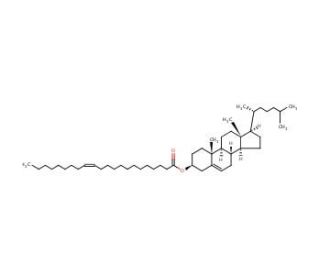

Cholesteryl erucate (CAS 24516-39-0)
QUICK LINKS
Cholesteryl erucate, a chemical compound of scientific interest, has been extensively investigated for its mechanisms of action and diverse research applications. One area of research focuses on its utilization as a lipid-based material in the development of functional biomaterials. Cholesteryl erucate has been employed as a building block for the synthesis of lipids with tailored properties. Researchers have explored its incorporation into lipid structures to modulate their physical and chemical characteristics. This compound has shown promise in the formulation of liposomes, lipid nanoparticles, and lipid bilayers, where it contributes to enhanced stability, controlled release of encapsulated substances, and improved encapsulation efficiency. Additionally, cholesteryl erucate has been studied for its self-assembly properties, particularly in the formation of lipid-based nanostructures. These nanostructures have been investigated for various applications, including their role as drug delivery systems, gene carriers, and imaging agents. Furthermore, cholesteryl erucate has been explored in the development of biomaterial coatings and interfaces. Its compatibility with different substrates allows for the creation of functional surfaces with desired properties, such as improved biocompatibility and controlled release capabilities. Ongoing scientific research on cholesteryl erucate continues to deepen our understanding of its mechanisms of action and its potential applications in biomaterials, nanotechnology, and surface science research. These research applications contribute to the advancement of innovative materials and technologies across various scientific disciplines.
Cholesteryl erucate (CAS 24516-39-0) References
- Two-dimensional paper chromatography of cholesteryl esters. A new method for the separation of critical pairs. | MICHALEC, C., et al. 1962. J Chromatogr. 9: 237-41. PMID: 13935450
- Rapid quantification of free cholesterol in tears using direct insertion/electron ionization-mass spectrometry. | Wei, XE., et al. 2013. Invest Ophthalmol Vis Sci. 54: 8027-35. PMID: 24255037
- Response of rat adrenal cholesteryl esters to cold stress. | Walker, BL. and Carney, JA. 1971. Lipids. 6: 797-804. PMID: 5127475
- Physical properties of cholesteryl esters. | Ginsburg, GS., et al. 1984. Prog Lipid Res. 23: 135-67. PMID: 6399750
- Cholesteryl ester hydrolase activity in adrenal homogenates from normal and essential fatty acid-deficient female rats. | Young, AK. and Walker, BL. 1982. Lipids. 17: 634-8. PMID: 7144451
- Temperature-dependent molecular motions of cholesterol esters: a carbon-13 nuclear magnetic resonance study. | Ginsburg, GS., et al. 1982. Biochemistry. 21: 6857-67. PMID: 7159569
- Physical properties of cholesteryl esters having 20 carbons or more. | Ginsburg, GS. and Small, DM. 1981. Biochim Biophys Acta. 664: 98-107. PMID: 7236700
- Evaluation of a high-performance liquid chromatography method for isolation and quantitation of cholesterol and cholesteryl esters. | Carroll, RM. and Rudel, LL. 1981. J Lipid Res. 22: 359-63. PMID: 7240962
- Biomarkers of dietary fat composition in young adults with a parental history of premature coronary heart disease compared with controls. The EARS Study. | Rosseneu, M., et al. 1994. Atherosclerosis. 108: 127-36. PMID: 7980712
- Molecular organization and motions of cholesteryl esters in crystalline and liquid crystalline phases: a 13C and 1H magic angle spinning NMR study. | Guo, W. and Hamilton, JA. 1993. Biochemistry. 32: 9038-52. PMID: 8369277
Ordering Information
| Product Name | Catalog # | UNIT | Price | Qty | FAVORITES | |
Cholesteryl erucate, 100 mg | sc-214697 | 100 mg | $40.00 |