
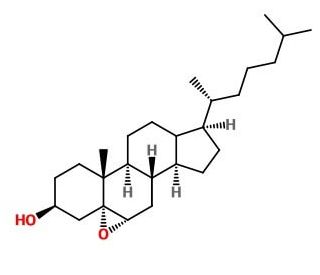

Cholesterol 5α,6α-epoxide (CAS 1250-95-9)
See product citations (1)
QUICK LINKS
Cholesterol 5α, 6α-epoxide, an oxysterol formed through the auto-oxidation of cholesterol, belongs to a class of cholesterol derivatives characterized by an epoxide group. Its significance lies in its role as a vital constituent of cell membranes and its involvement in numerous cellular processes. Through laboratory investigations, Cholesterol 5α, 6α-epoxide has been instrumental in exploring cell membrane structure and function, as well as elucidating the physiological effects of cholesterol on cellular systems. The versatility of Cholesterol 5α, 6α-epoxide extends to various research applications, encompassing the examination of cell membrane dynamics, regulation of cholesterol metabolism, and the impact of cholesterol on cellular behavior. Furthermore, it has proven valuable in deciphering the influence of cholesterol on the cardiovascular system and investigating mechanisms related to cell death and apoptosis. A key aspect of Cholesterol 5α, 6α-epoxide is its ability to act as an agonist for the nuclear receptor liver X receptor (LXR). LXR serves as a transcription factor responsible for governing the expression of genes involved in cholesterol metabolism and other essential metabolic pathways. By binding to LXR, Cholesterol 5α, 6α-epoxide prompts the activation of genes associated with cholesterol metabolism and related metabolic pathways, ultimately contributing to the regulation of cellular cholesterol levels. Moreover, Cholesterol 5α, 6α-epoxide has demonstrated its capability to influence the expression of genes involved in processes such as inflammation, oxidative stress, and cell death, further expanding its impact in cellular signaling and functional regulation.
Cholesterol 5α,6α-epoxide (CAS 1250-95-9) References
- Etiologic related studies of ultraviolet light-mediated carcinogenesis. | Black, HS. and Chan, JT. 1976. Oncology. 33: 119-22. PMID: 1012646
- 7beta-hydroxycholesterol induces Ca(2+) oscillations, MAP kinase activation and apoptosis in human aortic smooth muscle cells. | Ares, MP., et al. 2000. Atherosclerosis. 153: 23-35. PMID: 11058697
- Comparative effects of phytosterol oxides and cholesterol oxides in cultured macrophage-derived cell lines. | Adcox, C., et al. 2001. J Agric Food Chem. 49: 2090-5. PMID: 11308372
- Distribution of cholesterol-5alpha,6alpha-epoxide formation and its metabolism in mouse skin. | Chan, JT. and Black, HS. 1976. J Invest Dermatol. 66: 112-6. PMID: 1245749
- Comparison of the cytotoxic, pro-oxidant and pro-inflammatory characteristics of different oxysterols. | Lemaire-Ewing, S., et al. 2005. Cell Biol Toxicol. 21: 97-114. PMID: 16142584
- The effect of oxysterols, individually and as a representative mixture from food, on in vitro cultured bovine ovarian granulosa cells. | Hall, MC. 2006. Mol Cell Biochem. 292: 1-11. PMID: 16983501
- 7-Ketocholesterol and cholesterol-5alpha,6alpha-epoxide induce smooth muscle cell migration and proliferation through the epidermal growth factor receptor/phosphoinositide 3-kinase/Akt signaling pathways. | Liao, PL., et al. 2010. Toxicol Lett. 197: 88-96. PMID: 20466046
- Metabolomic profile in pancreatic cancer patients: a consensus-based approach to identify highly discriminating metabolites. | Di Gangi, IM., et al. 2016. Oncotarget. 7: 5815-29. PMID: 26735340
- Analysis of native and oxidized low-density lipoprotein oxysterols using gas chromatography-mass spectrometry with selective ion monitoring. | Mori, TA., et al. 1996. Redox Rep. 2: 25-34. PMID: 27414510
- Food Protein Sterylation: Chemical Reactions between Reactive Amino Acids and Sterol Oxidation Products under Food Processing Conditions. | Kamgang Nzekoue, F., et al. 2020. Foods. 9: PMID: 33348769
- The isolation and identification of cholesterol 5alpha, 6alpha-epoxide from liver of hairless mice. | Black, HS. and Laseter, JL. 1976. Comp Biochem Physiol C Comp Pharmacol. 53: 29-31. PMID: 3379
- Skin carcinogenesis: cholesterol-5alpha,6alpha-epoxide hydrase activity in mouse skin irradiated with ultraviolet light. | Chan, JT. and Black, HS. 1974. Science. 186: 1216-7. PMID: 4473824
- Determination of cholesterol oxidation products in human plasma by isotope dilution-mass spectrometry. | Dzeletovic, S., et al. 1995. Anal Biochem. 225: 73-80. PMID: 7778789
Ordering Information
| Product Name | Catalog # | UNIT | Price | Qty | FAVORITES | |
Cholesterol 5α,6α-epoxide, 50 mg | sc-214687 | 50 mg | $95.00 |