
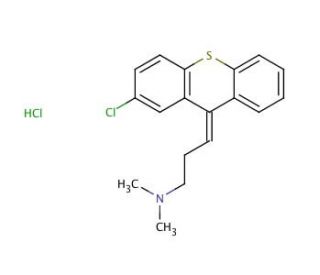

Chlorprothixene Hydrochloride (CAS 6469-93-8)
See product citations (2)
QUICK LINKS
Chlorprothixene Hydrochloride is a synthetic, tricyclic thioxanthene derivative with significant neuropharmacological activity, primarily functioning as a potent antagonist of several neurotransmitter receptors in the brain, including dopamine D1 and D2 receptors, serotonin (5-HT) receptors, α1-adrenergic receptors, and histamine H1 receptors. Its mechanism of action involves the blockade of these receptors, which modulates the neurotransmitter levels in the central nervous system, thereby altering neuronal activity and neurotransmission pathways. This modulation is for investigating the complex processes of neurotransmission, providing valuable insights into the understanding of neural circuitry and the fundamental mechanisms underlying various neurological conditions. Chlorprothixene Hydrochloride serves as a vital tool in neuropharmacological research, offering a means to explore the effects of neurotransmitter regulation on brain function, behavior, and the development of potential interventions for neurologically based disorders. Its broad receptor affinity makes it particularly useful in experimental models aimed at dissecting the roles of specific neurotransmitter systems in cognitive processes, neural plasticity, and neurogenesis, thus contributing significantly to the advancement of neuroscience research.
Chlorprothixene Hydrochloride (CAS 6469-93-8) References
- Sensitive spectrophotometric methods for quantitative determination of chlorprothixene in pharmaceutical dosage form. | Misiuk, W. 2006. Pak J Pharm Sci. 19: 87-94. PMID: 16751116
- Non-redundant coding of aversive odours in the main olfactory pathway. | Dewan, A., et al. 2013. Nature. 497: 486-9. PMID: 23624375
- Improved quality-by-design compliant methodology for method development in reversed-phase liquid chromatography. | Debrus, B., et al. 2013. J Pharm Biomed Anal. 84: 215-23. PMID: 23850937
- Field-amplified sample injection coupled with pseudo-isotachophoresis technique for sensitive determination of selected psychiatric drugs in human urine samples after dispersive liquid-liquid microextraction. | Dziomba, S., et al. 2014. Anal Chim Acta. 811: 88-93. PMID: 24456599
- Spatial receptive fields in the retina and dorsal lateral geniculate nucleus of mice lacking rods and cones. | Procyk, CA., et al. 2015. J Neurophysiol. 114: 1321-30. PMID: 26084909
- Thy1 transgenic mice expressing the red fluorescent calcium indicator jRGECO1a for neuronal population imaging in vivo. | Dana, H., et al. 2018. PLoS One. 13: e0205444. PMID: 30308007
- Homer1a Is Required for Establishment of Contralateral Bias and Maintenance of Ocular Dominance in Mouse Visual Cortex. | Chokshi, V., et al. 2019. J Neurosci. 39: 3897-3905. PMID: 30867257
- Identification of a dopamine receptor in Sinonovacula constricta and its antioxidant responses. | Niu, D., et al. 2020. Dev Comp Immunol. 103: 103512. PMID: 31585193
- Age-Related Cognitive and Motor Decline in a Mouse Model of CDKL5 Deficiency Disorder is Associated with Increased Neuronal Senescence and Death. | Gennaccaro, L., et al. 2021. Aging Dis. 12: 764-785. PMID: 34094641
- Inhibition of Indigoidine Synthesis as a High-Throughput Colourimetric Screen for Antibiotics Targeting the Essential Mycobacterium tuberculosis Phosphopantetheinyl Transferase PptT. | Brown, AS., et al. 2021. Pharmaceutics. 13: PMID: 34371757
- Cellular-resolution monitoring of ischemic stroke pathologies in the rat cortex. | Chornyy, S., et al. 2021. Biomed Opt Express. 12: 4901-4919. PMID: 34513232
- Visual System Hyperexcitability and Compromised V1 Receptive Field Properties in Early-Stage Retinitis Pigmentosa in Mice. | Leinonen, H., et al. 2022. eNeuro. 9: PMID: 35701168
- Crystal and molecular structures of tricyclic neuroleptics. | Klein, CL., et al. 1994. J Pharm Sci. 83: 1253-6. PMID: 7830241
- Development of a liquid chromatographic method for the control of related substances in chlorprothixene hydrochloride. | Duignan, GM., et al. 1996. J Pharm Biomed Anal. 14: 451-6. PMID: 8729644
Ordering Information
| Product Name | Catalog # | UNIT | Price | Qty | FAVORITES | |
Chlorprothixene Hydrochloride, 1 g | sc-211077 | 1 g | $62.00 |