
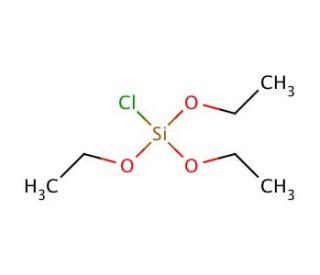

Chlorotriethoxysilane (CAS 4667-99-6)
Available in US only.
LINK RAPIDI
Il clorotrietossisilano (CTES) è un composto liquido trasparente caratterizzato dalla formula chimica Cl(OC2H5)3Si. È un composto attivo di organosilicio ampiamente utilizzato in numerose applicazioni, tra cui la catalisi, l'uso di tensioattivi, la funzionalità dei reagenti e come precursore nella sintesi di diversi silani. Grazie alla sua versatilità, il clorotrietossisilano è utile in laboratorio, nei processi industriali e persino nelle applicazioni domestiche. Il clorotrietossisilano è un reagente fondamentale nella sintesi organica. Facilita la conversione degli alcoli in cloruri alchilici e partecipa alla formazione di eteri, esteri e vari gruppi funzionali. Inoltre, svolge un ruolo cruciale nella sintesi dei silani, che comprendono legami silicio-ossigeno. Inoltre, il clorotrietossisilano contribuisce alla produzione di polisilossani, che rappresentano polimeri composti da unità silossaniche ricorrenti. Grazie alla sua natura altamente reattiva, il clorotrietossisilano si impegna facilmente in reazioni chimiche con altri composti. Reagisce con gli alcoli per generare cloruri alchilici e con le ammine per produrre ammidi. Inoltre, può formare esteri quando reagisce con gli acidi. In particolare, l'idrolisi del gruppo silanolo attraverso la reazione del clorotrietossisilano con l'acqua riveste un'importanza particolare come passaggio cruciale nella sintesi di silani e polisilossani.
Chlorotriethoxysilane (CAS 4667-99-6) Referenze
- Sintesi e proprietà dell'organosilice mesoporoso periodico (PMO) di 1,3,5-benzene: un nuovo PMO aromatico con attacchi a tre punti e trasformazioni termiche uniche. | Kuroki, M., et al. 2002. J Am Chem Soc. 124: 13886-95. PMID: 12431120
- Silanetrioli stabili contenenti gruppi tert-alcossi: precursori versatili di nanomateriali a base di silossani. | Suzuki, J., et al. 2008. Chemistry. 14: 973-80. PMID: 17992681
- Modifica di sensori a micro-cantilever con sol-gel per migliorare le prestazioni e immobilizzare fasi chimicamente selettive. | Fagan, BC., et al. 2000. Talanta. 53: 599-608. PMID: 18968147
- Sintesi di 4-aril- e 4-alchil-2-silil-1,3-butadieni e loro reazioni di Diels-Alder/cross-coupling. | Junker, CS., et al. 2010. J Org Chem. 75: 8155-65. PMID: 21069964
- Blocco di costruzione dendritico e nanometrico per materiali a base di silossano: un dendrimero di sferosilicato. | Kawahara, K., et al. 2011. Chemistry. 17: 13188-96. PMID: 22038556
- Film sottili di silice mesoporosa funzionalizzati come materiale ottico non lineare sintonizzabile. | Laskowska, M., et al. 2017. Nanoscale. 9: 12110-12123. PMID: 28800139
- Proprietà fotovoltaiche e durata a lungo termine di celle solari sensibilizzate alle porfirine con gruppi di ancoraggio a base di silicio. | Higashino, T., et al. 2017. ACS Omega. 2: 6958-6967. PMID: 31457279
Informazioni ordini
| Nome del prodotto | Codice del prodotto | UNITÀ | Prezzo | Quantità | Preferiti | |
Chlorotriethoxysilane, 25 g | sc-234347 | 25 g | $203.00 | |||
| USA: Disponibile solo negli Stati Uniti | ||||||