

Chlorophyll b (CAS 519-62-0)
QUICK LINKS
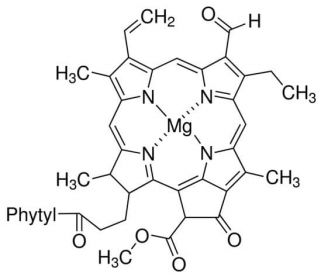
Chlorophyll b, with the CAS number 519-62-0, is a vital photosynthetic pigment found predominantly in green plants, algae, and certain cyanobacteria. It plays a crucial role in the photosynthesis process by complementing chlorophyll a in absorbing light energy, particularly in the blue and red-light spectrum, which is less efficiently captured by chlorophyll a. Structurally similar to chlorophyll a, chlorophyll b differs primarily in the substitution of a formyl group in place of a methyl group on the chlorin ring, which shifts its light absorption peak towards the green, enhancing its ability to capture light under shaded or deeper water conditions. This ability makes chlorophyll b an essential agent in the photosynthetic light-harvesting complexes, where it transfers the absorbed light energy to chlorophyll a, facilitating the conversion of solar energy into chemical energy. In research, chlorophyll b′s distinct absorption properties have been utilized in studies of plant ecology and physiology, particularly in understanding light adaptation strategies and energy transfer mechanisms within different plant species. Its role is also investigated in the study of plant stress responses, such as changes in pigment composition under various light intensities and qualities, providing insights into adaptive traits and photosynthetic efficiency. Chlorophyll b′s unique properties thus not only contribute to the primary production in ecosystems but also serve as a focal point in ecological and environmental research.
Chlorophyll b (CAS 519-62-0) References
- SPECTRAL ABSORPTION PROPERTIES OF ORDINARY AND FULLY DEUTERIATED CHLOROPHYLLS A AND B. | STRAIN, HH., et al. 1963. Biochim Biophys Acta. 75: 306-11. PMID: 14104939
- Unlocking the potential of SiO2 and CeO2 nanoparticles for arsenic mitigation in Vigna mungo L. Hepper (Blackgram). | Anand, V. and Pandey, A. 2024. Environ Sci Pollut Res Int. 31: 34473-34491. PMID: 38704781
- Crucial role of SWL1 in chloroplast biogenesis and development in Arabidopsis thaliana. | Wang, Y., et al. 2024. Plant Cell Rep. 43: 135. PMID: 38704787
- Seed pretreatment with brassinosteroids stimulates sunflower immunity against parasitic weed (Orobanche cumana) infection. | Zhang, N., et al. 2024. Physiol Plant. 176: e14324. PMID: 38705866
- Gamma-aminobutyric acid (GABA) improves salinity stress tolerance in soybean seedlings by modulating their mineral nutrition, osmolyte contents, and ascorbate-glutathione cycle. | Qian, Z., et al. 2024. BMC Plant Biol. 24: 365. PMID: 38706002
- Pervasive influence of heavy metals on metabolic pathways is potentially relieved by hesperidin to enhance the phytoremediation efficiency of Bassia scoparia. | Hussain, M., et al. 2024. Environ Sci Pollut Res Int. 31: 34526-34549. PMID: 38709411
- Sustainable microalgal biomass as a potential functional food and its applications in food industry: a comprehensive review. | Dhandwal, A., et al. 2024. Environ Sci Pollut Res Int.. PMID: 38710849
- Effects of high dietary inclusion of Arthrospira platensis, either extruded or supplemented with a super-dosing multi-enzyme mixture, on broiler growth performance and major meat quality parameters. | Costa, MM., et al. 2024. BMC Vet Res. 20: 176. PMID: 38711127
- Physiological, biochemical and transcriptomic insights into the mechanisms by which molybdenum mitigates cadmium toxicity in Triticum aestivum L. | Wu, M., et al. 2024. J Hazard Mater. 472: 134516. PMID: 38714056
- Physiology and transcriptome analysis of Artemisia argyi adaptation and accumulation to soil cadmium. | Yang, Y., et al. 2024. Ecotoxicol Environ Saf. 278: 116397. PMID: 38714088
Ordering Information
| Product Name | Catalog # | UNIT | Price | Qty | FAVORITES | |
Chlorophyll b, 1 mg | sc-214685 | 1 mg | $223.00 | |||
Chlorophyll b, 5 mg | sc-214685A | 5 mg | $869.00 |