
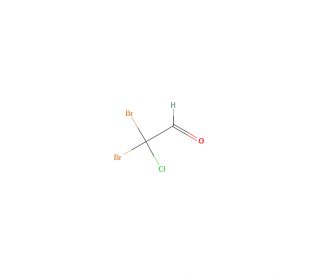

Chlorodibromoacetaldehyde (CAS 64316-11-6)
QUICK LINKS
Chlorodibromoacetaldehyde is a chemical compound that functions as a reagent in organic synthesis. Its mechanism of action involves its ability to undergo nucleophilic substitution reactions with various nucleophiles, such as amines and alcohols, to form corresponding chlorodibromoacetals. Chlorodibromoacetaldehyde may play a role in the modification of organic molecules by introducing specific functional groups at targeted positions, allowing for the creation of diverse chemical structures. Chlorodibromoacetaldehyde′s mechanism of action involves its reactivity with nucleophiles, leading to the formation of new carbon-carbon and carbon-heteroatom bonds. Chlorodibromoacetaldehyde′s functional role in the experimental applications enables the synthesis of complex organic compounds with tailored properties, contributing to the advancement of chemical research and development.
Chlorodibromoacetaldehyde (CAS 64316-11-6) References
- Potential health effects of drinking water disinfection by-products using quantitative structure toxicity relationship. | Moudgal, CJ., et al. 2000. Toxicology. 147: 109-31. PMID: 10874158
- Use of mechanism-based structure-activity relationships analysis in carcinogenic potential ranking for drinking water disinfection by-products. | Woo, YT., et al. 2002. Environ Health Perspect. 110 Suppl 1: 75-87. PMID: 11834465
- Halogenated acetaldehydes: analysis, stability and fate in drinking water. | Koudjonou, BK. and LeBel, GL. 2006. Chemosphere. 64: 795-802. PMID: 16376407
- Formation of halogenated acetaldehydes, and occurrence in Canadian drinking water. | Koudjonou, B., et al. 2008. Chemosphere. 72: 875-81. PMID: 18499222
- Daily bursts of biogenic cyanogen bromide (BrCN) control biofilm formation around a marine benthic diatom. | Vanelslander, B., et al. 2012. Proc Natl Acad Sci U S A. 109: 2412-7. PMID: 22308324
- To add or not to add: the use of quenching agents for the analysis of disinfection by-products in water samples. | Kristiana, I., et al. 2014. Water Res. 59: 90-8. PMID: 24793107
- Women exposure during pregnancy to haloacetaldehydes and haloacetonitriles in drinking water and risk of small-for-gestational-age neonate. | Ileka-Priouzeau, S., et al. 2015. Environ Res. 137: 338-48. PMID: 25601737
- Chloramination of wastewater effluent: Toxicity and formation of disinfection byproducts. | Le Roux, J., et al. 2017. J Environ Sci (China). 58: 135-145. PMID: 28774602
- Occurrence and fate of ozonation disinfection by-products in two Canadian drinking water systems. | Laflamme, O., et al. 2020. Chemosphere. 260: 127660. PMID: 32758783
Ordering Information
| Product Name | Catalog # | UNIT | Price | Qty | FAVORITES | |
Chlorodibromoacetaldehyde, 100 mg | sc-501091 | 100 mg | $312.00 |