
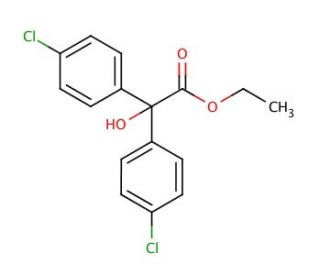

Chlorobenzilate (CAS 510-15-6)
QUICK LINKS
Chlorobenzilate is studied in the field of environmental chemistry due to its persistence and behavior in agricultural. Chlorobenzilate focuses on its degradation pathways, its interaction with soil and water, and its impact on non-target organisms. Chlorobenzilate is also investigated for its potential role in resistance management strategies, where understanding its mode of action can help in developing more sustainable pest control methods. Chlorobenzilate studies related to the synthesis of more environmentally friendly compounds with similar functional properties. Examining the metabolic pathways through which Chlorobenzilate is broken down by various organisms, which is for assessing its environmental fate and ecological risk.
Chlorobenzilate (CAS 510-15-6) References
- Collaborative study of a gas-liquid chromatographic method for the analysis of chlorobenzilate and chloropropylate. | Hofberg, AH., et al. 1975. J Assoc Off Anal Chem. 58: 516-9. PMID: 1141178
- [Toxicity of insecticides-acaricides were studied for three phytoghagous mites (Acari: Tetranychidae) using two different laboratory methods (author's transl)]. | Chiavegato, LG., et al. 1975. Arq Inst Biol (Sao Paulo). 42: 173-82. PMID: 1236046
- Bioassay of chlorobenzilate for possible carcinogenicity. | ,. 1978. Natl Cancer Inst Carcinog Tech Rep Ser. 75: 1-107. PMID: 12830222
- Application of QSTRs in the selection of a surrogate toxicity value for a chemical of concern. | Moudgal, CJ., et al. 2003. Environ Sci Technol. 37: 5228-35. PMID: 14655712
- Designing safer (soft) drugs by avoiding the formation of toxic and oxidative metabolites. | Bodor, N. and Buchwald, P. 2004. Mol Biotechnol. 26: 123-32. PMID: 14764938
- Wastewater-based epidemiology approach to assess population exposure to pesticides: a review of a pesticide pharmacokinetic dataset. | Devault, DA. and Karolak, S. 2020. Environ Sci Pollut Res Int. 27: 4695-4702. PMID: 31907818
- Chlorobenzilate-induced effects on enzyme-altered foci in rat liver and intercellular communication in rat liver WB-F344 epithelial cells. | Flodström, S., et al. 1988. Cancer Lett. 43: 161-6. PMID: 3203334
- The carbinole acaricides: chlorobenzilate and chloropropylate. | Bartsch, E., et al. 1971. Residue Rev. 39: 1-93. PMID: 5127234
- Metabolism of 14C-chlorobenzilate and 14C-chloropropylate by Rhodotorula gracilis. | Miyazaki, S., et al. 1969. Appl Microbiol. 18: 972-6. PMID: 5392608
- Carcinomas of the liver and forestomach in mice ingesting chlorobenzilate. | Reuber, MD. 1977. Digestion. 16: 308-16. PMID: 615742
- Neurotransmitter receptors as targets for pesticides. | Eldefrawi, ME. and Eldefrawi, AT. 1983. J Environ Sci Health B. 18: 65-88. PMID: 6339601
- Toxic encephalopathy from chlorobenzilate poisoning: report of a case. | Ravindran, M. 1978. Clin Electroencephalogr. 9: 170-2. PMID: 737852
- Dissipation and movement of acaricide chlorobenzilate in the environment. | Wang, YS., et al. 1994. Ecotoxicol Environ Saf. 28: 193-200. PMID: 7525215
- Enhancement by non-mutagenic pesticides of GST-P positive hepatic foci development initiated with diethylnitrosamine in the rat. | Hoshiya, T., et al. 1993. Cancer Lett. 72: 59-64. PMID: 8402576
- Biological monitoring of occupational pesticides exposure. | He, F. 1993. Int Arch Occup Environ Health. 65: S69-76. PMID: 8406941
Ordering Information
| Product Name | Catalog # | UNIT | Price | Qty | FAVORITES | |
Chlorobenzilate, 100 mg | sc-239518 | 100 mg | $45.00 |