
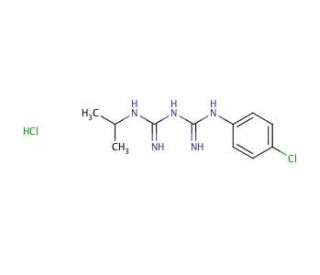

Chlorguanide Hydrochloride (CAS 637-32-1)
ACCÈS RAPIDE AUX LIENS
Le chlorhydrate de chlorguanide, un composé chimique aux propriétés antimicrobiennes notables, a été au centre de la recherche scientifique en raison de son mécanisme d'action intrigant. Ce composé exerce ses effets principalement en interférant avec le métabolisme microbien, perturbant ainsi des processus cellulaires vitaux. En ciblant des voies enzymatiques spécifiques essentielles à la croissance et à la reproduction microbiennes, le chlorhydrate de chlorguanide inhibe efficacement la prolifération de divers micro-organismes. Dans le cadre de la recherche, le chlorhydrate de chlorguanide a fait l'objet d'études approfondies sur son efficacité antimicrobienne contre divers agents pathogènes, notamment des bactéries, des champignons et des protozoaires. Les chercheurs ont exploré son mode d'action au niveau moléculaire, dévoilant les mécanismes biochimiques complexes qui sous-tendent son activité antimicrobienne. En outre, le chlorhydrate de chlorguanide a été utilisé comme outil dans des études portant sur l'écologie microbienne et la microbiologie environnementale. Sa capacité à cibler sélectivement les populations microbiennes a facilité les recherches sur la dynamique des communautés microbiennes et les rôles écologiques de microorganismes spécifiques dans divers écosystèmes. En outre, les propriétés antimicrobiennes du chlorhydrate de chlorguanide ont suscité l'intérêt pour ses applications potentielles, notamment dans la conservation des aliments et la microbiologie industrielle. En comprenant ses mécanismes d'action et en explorant son large spectre d'activité, les chercheurs visent à découvrir de nouvelles stratégies pour lutter contre les menaces microbiennes et faire progresser divers domaines de recherche scientifique.
Chlorguanide Hydrochloride (CAS 637-32-1) Références
- Anaphylaxie à la chlorhexidine. Rapport de cas. Implication des anticorps immunoglobuline E et identification d'un déterminant allergénique. | Pham, NH., et al. 2000. Clin Exp Allergy. 30: 1001-7. PMID: 10848923
- Comparaison du pouvoir antifibrillatoire de certains médicaments antipaludiques avec la quinidine et l'amide de procaïne. | BURNO, F., et al. 1954. Circ Res. 2: 414-5. PMID: 13190621
- Concepts actuels de la malaria; avec une revue de 510 admissions dans un hôpital pour vétérans. | SCHWARTZ, R., et al. 1950. AMA Arch Intern Med. 86: 837-56. PMID: 14777198
- NOUVEAU et remèdes non officiels: chlorhydrate de chlorguanide. | . 1950. J Am Med Assoc. 143: 815. PMID: 15421840
- Effets gamétocytocides et sporontocides des médicaments antipaludiques sur les parasites du paludisme. II. Action des inhibiteurs de la folico-réductase, du chlorguanide et de la pyriméthamine contre Plasmodium cynomolgi. | Omar, MS., et al. 1974. Exp Parasitol. 36: 167-77. PMID: 4413531
- Nouvelle étude de la structure du chlorhydrate de chlorguanide. | Ammon, HL. and Plastas, LA. 1973. J Med Chem. 16: 169-71. PMID: 4683114
- Synthèse et activité biologique de la (6aS)-10,11-dihydroxyaporphine, l'antipode optique de l'apomorphine. | Saari, WS. and King, SW. 1973. J Med Chem. 16: 171-2. PMID: 4683115
- Traitement de la leishmaniose cutanée américaine par le pamoate de cycloguanil. | Pena Chavarria, A., et al. 1968. Trans R Soc Trop Med Hyg. 62: 550-5. PMID: 5671542
- Stabilisation de molécules entières d'hémocyanines de gastéropodes par la chlorhexidine. | Verschueren, LJ., et al. 1980. Int J Pept Protein Res. 16: 130-4. PMID: 7461895
Informations pour la commande
| Nom du produit | Ref. Catalogue | COND. | Prix HT | QTÉ | Favoris | |
Chlorguanide Hydrochloride, 25 mg | sc-211068 | 25 mg | $227.00 |