
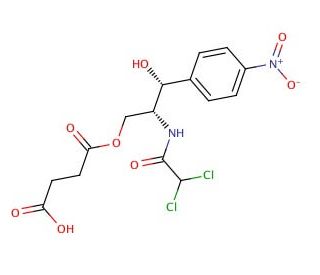

Chloramphenicol succinate (CAS 3544-94-3)
QUICK LINKS
Chloramphenicol succinate is a compound of interest in the fields of biochemistry and molecular biology, particularly for its role in studies of protein synthesis within prokaryotic organisms. It is used as a tool to understand the function of bacterial ribosomes and the mechanism of action of inhibitors that bind to the peptidyl transferase component of the 50S ribosomal subunit. Research involving Chloramphenicol succinate is instrumental in elucidating the intricacies of translation inhibition and the selectivity of binding to bacterial versus eukaryotic ribosomes. This compound also aids in the study of bacterial resistance mechanisms, such as the production of chloramphenicol acetyltransferase, an enzyme that inactivates chloramphenicol. Furthermore, Chloramphenicol succinate′s properties are utilized in biotechnological applications, where it may serve as a selection agent in molecular cloning procedures that require the suppression of bacterial host protein synthesis.
Chloramphenicol succinate (CAS 3544-94-3) References
- Metabolism of chloramphenicol succinate in human bone marrow. | Ambekar, CS., et al. 2000. Eur J Clin Pharmacol. 56: 405-9. PMID: 11009050
- A pharmacological study of chloramphenicol in horses. | Sisodia, CS., et al. 1975. Can J Comp Med. 39: 216-23. PMID: 1125836
- Chloramphenicol succinate, a competitive substrate and inhibitor of succinate dehydrogenase: possible reason for its toxicity. | Ambekar, CS., et al. 2004. Toxicol In Vitro. 18: 441-7. PMID: 15130601
- Profound cardioprotection with chloramphenicol succinate in the swine model of myocardial ischemia-reperfusion injury. | Sala-Mercado, JA., et al. 2010. Circulation. 122: S179-84. PMID: 20837911
- Lack of predictability of chloramphenicol toxicity in paediatric patients. | Nahata, MC. 1989. J Clin Pharm Ther. 14: 297-303. PMID: 2793954
- Structure-Activity Relationship of Peptide-Conjugated Chloramphenicol for Inhibiting Escherichia coli. | Wang, J., et al. 2019. J Med Chem. 62: 10245-10257. PMID: 31670952
- The monitoring of serum chloramphenicol levels in children with severe infections. | Ekblad, H., et al. 1985. J Antimicrob Chemother. 15: 489-94. PMID: 4008381
- Clinical pharmacokinetics of chloramphenicol and chloramphenicol succinate. | Ambrose, PJ. 1984. Clin Pharmacokinet. 9: 222-38. PMID: 6375931
- Chloramphenicol serum concentration falls during chloramphenicol succinate dosing. | Nahata, MC. and Powell, DA. 1983. Clin Pharmacol Ther. 33: 308-13. PMID: 6825386
- Comparative bioavailability and pharmacokinetics of chloramphenicol after intravenous chloramphenicol succinate in premature infants and older patients. | Nahata, MC. and Powell, DA. 1983. Dev Pharmacol Ther. 6: 23-32. PMID: 6839912
- Pharmacokinetics of intravenous chloramphenicol sodium succinate in adult patients with normal renal and hepatic function. | Burke, JT., et al. 1982. J Pharmacokinet Biopharm. 10: 601-14. PMID: 7182457
- Bioavailability and clearance of chloramphenicol after intravenous chloramphenicol succinate. | Nahata, MC. and Powell, DA. 1981. Clin Pharmacol Ther. 30: 368-72. PMID: 7273601
- Chloramphenicol succinate pharmacokinetics in Macaca nemestrina: dose dependency study. | Koup, JR., et al. 1981. J Pharmacol Exp Ther. 219: 316-20. PMID: 7288623
- Relative bioavailability of intravenous chloramphenicol succinate and oral chloramphenicol palmitate in infants and children. | Kauffman, RE., et al. 1981. J Pediatr. 99: 963-7. PMID: 7310593
- Pharmacokinetics of chloramphenicol and chloramphenicol succinate in infants and children. | Kauffman, RE., et al. 1981. J Pediatr. 98: 315-20. PMID: 7463235
Ordering Information
| Product Name | Catalog # | UNIT | Price | Qty | FAVORITES | |
Chloramphenicol succinate, 5 mg | sc-391793 | 5 mg | $87.00 |