
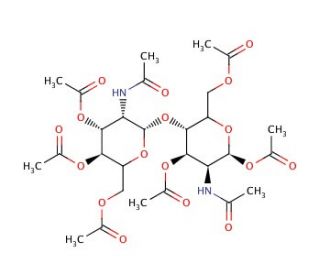

Chitobiose Octaacetate (CAS 41670-99-9)
QUICK LINKS
Chitobiose Octaacetate is a chemically modified form of chitobiose, a disaccharide composed of two glucosamine units linked by a β-(1→4) bond, extensively acetylated to enhance its chemical stability and solubility for use in research applications. This derivative is particularly valuable in the study of chitinase enzymes, which play crucial roles in the degradation of chitin, a major component of the exoskeletons of arthropods and the cell walls of fungi. The octaacetate modification of chitobiose serves as a protective mechanism, preventing premature hydrolysis and allowing researchers to explore enzyme-substrate interactions with greater specificity and control. By studying how chitinases interact with this substrate, scientists can gain insights into the catalytic mechanisms of these enzymes, which is essential for understanding natural chitin degradation processes and developing synthetic routes to mimic or inhibit these reactions. In research, Chitobiose Octaacetate is used primarily to investigate the kinetics and dynamics of chitinase action, helping to explain factors that influence enzyme specificity and activity. This research is crucial for advancing our understanding of biochemical pathways involved in fungal and microbial ecology, as well as in agricultural applications where chitinase enzymes are targeted to combat fungal infections. These studies are strictly scientific, focusing solely on the biochemical and enzymological aspects.
Chitobiose Octaacetate (CAS 41670-99-9) References
- Development of recombinant, immobilised beta-1,4-mannosyltransferase for use as an efficient tool in the chemoenzymatic synthesis of N-linked oligosaccharides. | Revers, L., et al. 1999. Biochim Biophys Acta. 1428: 88-98. PMID: 10366763
- The chitinase system of a strain of Streptomyces griseus. | BERGER, LR. and REYNOLDS, DM. 1958. Biochim Biophys Acta. 29: 522-34. PMID: 13584354
- Synthesis of a peripheral trisaccharide sequence of lutropin, a pituitary glycoprotein hormone; use of chitobiose as a key starting material. | Nishimura, S. and Kuzuhara, H. 1990. Carbohydr Res. 206: 207-17. PMID: 2073633
- Synthesis and X-ray crystallographic investigation of N-(β-D-glycosyl)butanamides derived from GlcNAc and chitobiose as analogs of the conserved chitobiosylasparagine linkage of N-glycoproteins. | Mathiselvam, M., et al. 2013. Carbohydr Res. 380: 37-44. PMID: 23916853
- Quantitative study of yeast Alg1 beta-1, 4 mannosyltransferase activity, a key enzyme involved in protein N-glycosylation. | Li, ST., et al. 2017. Biochim Biophys Acta Gen Subj. 1861: 2934-2941. PMID: 27670784
- Alg mannosyltransferases: From functional and structural analyses to the lipid-linked oligosaccharide pathway reconstitution. | Wang, N., et al. 2022. Biochim Biophys Acta Gen Subj. 1866: 130112. PMID: 35217128
- The stereospecificity of human, hen, and papaya lysozymes. | Dahlquist, FW., et al. 1969. Biochemistry. 8: 694-700. PMID: 5815782
- Separation of glycosaminoglycan saccharide and glycoside mixtures by gel filtration. | Raftery, MA., et al. 1969. Anal Biochem. 30: 427-35. PMID: 5821304
- Selective cleavage of the glycosidic bond in acetylated 2-acetamido-2-deoxy-. beta.-D-glucopyranosides by a chemical transglycosylation | Salo W L, Fletcher Jr H G. 1968. The Journal of Organic Chemistry. 33: 3585-3588.
Ordering Information
| Product Name | Catalog # | UNIT | Price | Qty | FAVORITES | |
Chitobiose Octaacetate, 100 mg | sc-211065 | 100 mg | $388.00 |