
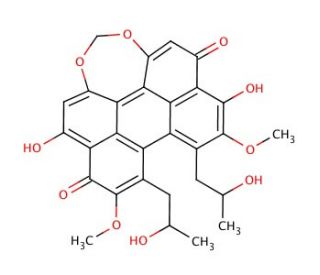

Cercosporin (CAS 35082-49-6)
See product citations (1)
QUICK LINKS
Cercosporin is a natural fungal pigment and toxin produced by various species of the Cercospora fungus. It belongs to the family of perylenequinone compounds. Cercosporin is well-known for its potent phytotoxic and cytotoxic properties, making it an important compound of interest in both agricultural and biomedical research. In the field of agriculture, cercosporin has been recognized for its role as a virulence factor in plant diseases caused by Cercospora species. It acts as a photosensitizer, generating reactive oxygen species upon exposure to light. This oxidative stress can lead to cellular damage and the destruction of plant tissues, contributing to disease development and crop yield loss. Researchers are studying cercosporin′s interactions with plants, exploring strategies to control Cercospora diseases and mitigate their impact on agricultural productivity. In the biomedical field, cercosporin′s cytotoxic properties have drawn attention for their potential applications in cancer research. It has shown promising anti-tumor activity in vitro by inducing oxidative stress and triggering apoptotic cell death in cancer cells.
Cercosporin (CAS 35082-49-6) References
- A novel gene required for cercosporin toxin resistance in the fungus Cercospora nicotianae. | Chung, KR., et al. 1999. Mol Gen Genet. 262: 382-9. PMID: 10517336
- Involvement of calcium/calmodulin signaling in cercosporin toxin biosynthesis by Cercospora nicotianae. | Chung, KR. 2003. Appl Environ Microbiol. 69: 1187-96. PMID: 12571046
- The CTB1 gene encoding a fungal polyketide synthase is required for cercosporin biosynthesis and fungal virulence of Cercospora nicotianae. | Choquer, M., et al. 2005. Mol Plant Microbe Interact. 18: 468-76. PMID: 15915645
- Mutants of Cercospora kikuchii Altered in Cercosporin Synthesis and Pathogenicity. | Upchurch, RG., et al. 1991. Appl Environ Microbiol. 57: 2940-5. PMID: 16348567
- Light-induced production of singlet oxygen and superoxide by the fungal toxin, cercosporin. | Daub, ME. and Hangarter, RP. 1983. Plant Physiol. 73: 855-7. PMID: 16663313
- Production of cercosporin toxin by the phytopathogenic Cercospora fungi is affected by diverse environmental signals. | You, BJ., et al. 2008. Can J Microbiol. 54: 259-69. PMID: 18388998
- Characterization of Cercospora nicotianae Hypothetical Proteins in Cercosporin Resistance. | Beseli, A., et al. 2015. PLoS One. 10: e0140676. PMID: 26474162
- In vitro screening of calli of mungbean to cercosporin, a photoactivated toxin. | Kumar, P., et al. 2017. Indian J Exp Biol. 55: 113-21. PMID: 30184412
- Cercosporin From Pseudocercosporella capsellae and its Critical Role in White Leaf Spot Development. | Gunasinghe, N., et al. 2016. Plant Dis. 100: 1521-1531. PMID: 30686233
- Engineering Cercospora disease resistance via expression of Cercospora nicotianae cercosporin-resistance genes and silencing of cercosporin production in tobacco. | Thomas, E., et al. 2020. PLoS One. 15: e0230362. PMID: 32176712
- Cercosporin-Photocatalyzed [4+1]- and [4+2]-Annulations of Azoalkenes Under Mild Conditions. | Icyishaka, P., et al. 2020. J Vis Exp.. PMID: 32744529
- In Vitro Screening of Various Bacterially Produced Double-Stranded RNAs for Silencing Cercospora cf. flagellaris Target Genes and Suppressing Cercosporin Production. | Zivanovic, M. and Chen, ZY. 2021. Phytopathology. 111: 1228-1237. PMID: 33289403
- Enhanced cercosporin production by co-culturing Cercospora sp. JNU001 with leaf-spot-disease-related endophytic bacteria. | Zhou, T., et al. 2021. Microb Cell Fact. 20: 100. PMID: 33992112
- Cercosporin-bioinspired photoinactivation of harmful cyanobacteria under natural sunlight via bifunctional mechanisms. | Liu, M., et al. 2022. Water Res. 215: 118242. PMID: 35259559
Ordering Information
| Product Name | Catalog # | UNIT | Price | Qty | FAVORITES | |
Cercosporin, 5 mg | sc-255013 | 5 mg | $459.00 |