
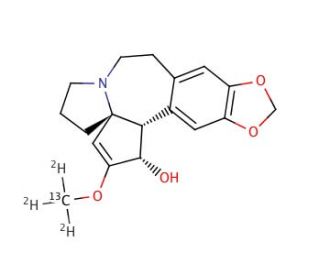

Cephalotaxine-13C,d3 (CAS 24316-19-6 (unlabeled))
QUICK LINKS
Cephalotaxine-13C,d3 is a stable isotope-labeled form of cephalotaxine, where specific carbon atoms are labeled with carbon-13 (13C) and hydrogen atoms are replaced with deuterium (d3). This labeling enhances the compound′s use in various scientific research applications, particularly for more precise tracking and analysis in studies involving mass spectrometry and nuclear magnetic resonance (NMR) spectroscopy. Cephalotaxine is a natural alkaloid found in the bark and leaves of trees belonging to the genus Cephalotaxus. This compound is part of the broader class of alkaloids known for their complex structures and biological activities. Cephalotaxine itself has attracted interest due to its role as a core structure in the synthesis of more biologically active derivatives. The primary mechanism of action of cephalotaxine involves the inhibition of tubulin polymerization. Cephalotaxine and its derivatives bind to tubulin at specific sites, disrupting the dynamic equilibrium needed for microtubule assembly. This inhibition affects crucial cellular processes such as cell division, intracellular transport, and the maintenance of cell shape and structure. In scientific research, Cephalotaxine-13C,d3 is particularly valuable for studying the metabolic and pharmacokinetic properties of cephalotaxine. The isotopic labels allow for clearer detection and quantification in biological samples, making it easier to observe how cephalotaxine is absorbed, distributed, metabolized, and excreted in experimental models. This information is essential for understanding the compound′s behavior and potential interactions within biological systems.
Ordering Information
| Product Name | Catalog # | UNIT | Price | Qty | FAVORITES | |
Cephalotaxine-13C,d3, 1 mg | sc-217873 | 1 mg | $430.00 |