
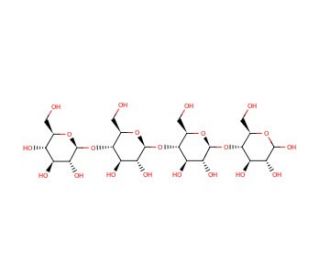

Cellotetraose (CAS 38819-01-1)
ENLACES RÁPIDOS
Cellotetraose es un tetrasacárido compuesto por cuatro moléculas de glucosa dispuestas en una cadena lineal, que sirve como sustrato crucial para varias celulasas y 1,4-β-D-glucano glucohidrolasas. Actúa como un producto final para ciertas celulasas como Cel9R de Clostridium thermocellum. Con su participación en la degradación de la celulosa, un componente vital de las paredes celulares de las plantas, así como su presencia en la hemicelulosa, una fibra dietética importante en las plantas, el cellotetraose tiene una importancia significativa. Esta molécula de azúcar asume un papel fundamental en los estudios del metabolismo de los carbohidratos debido a su estructura abundante y relativamente simple. Como resultado, encuentra un uso extensivo en la investigación científica. Cellotetraose contribuye a la investigación del metabolismo de los carbohidratos, arrojando luz sobre las funciones intrincadas de las enzimas involucradas en la descomposición de los carbohidratos, como celulasas, celobiasas, xilanasas, pectinasas, transportadores de glucosa y transportadores de sacarosa. Los investigadores aprovechan el cellotetraose para explorar la estructura y función de estas enzimas y proteínas involucradas en el metabolismo y transporte de carbohidratos. Sirve como una herramienta valiosa para descifrar sus mecanismos de acción, así como para desentrañar la biosíntesis de celobiosa y su papel como precursor de varias moléculas, incluyendo xilano, un polisacárido esencial. Enzimáticamente, Cellotetraose se descompone por celulasas y celobiasas, lo que conduce a la descomposición de sus monosacáridos constituyentes. Posteriormente, estos monosacáridos son sometidos a una degradación enzimática adicional por glucosidasas, xilanasas y otras enzimas relevantes. Este proceso culmina en la generación de moléculas más simples como glucosa y xilosa, que son utilizadas por las células para obtener energía y realizar diversas funciones celulares.
Cellotetraose (CAS 38819-01-1) Referencias
- Clonación y caracterización de la ruta catabólica de los glucooligosacáridos beta-glucano glucohidrolasa y celobiosa fosforilasa en el hipertermófilo marino Thermotoga neapolitana. | Yernool, DA., et al. 2000. J Bacteriol. 182: 5172-9. PMID: 10960102
- Caracterización de una forma soluble funcional de una endo-1,4-beta-glucanasa anclada a membrana de Brassica napus expresada heterológicamente en Pichia pastoris. | Mølhøj, M., et al. 2001. Plant Physiol. 127: 674-84. PMID: 11598241
- Un nuevo componente importante en el celulosoma de Clostridium thermocellum es una endo-beta-1,4-glucanasa procesiva que produce celotetraosa. | Zverlov, VV., et al. 2005. FEMS Microbiol Lett. 249: 353-8. PMID: 16006068
- Fuerzas de Van der Waals frente a fuerzas de enlace de hidrógeno en un análogo cristalino de la celotetraosa: solvato de ciclohexil 4'-O-ciclohexil beta-D-celobiósido de ciclohexano. | Yoneda, Y., et al. 2008. J Am Chem Soc. 130: 16678-90. PMID: 19554694
- La celotriosa y la celotetraosa como inductores de los genes que codifican las celobiohidrolasas en el basidiomiceto Phanerochaete chrysosporium. | Suzuki, H., et al. 2010. Appl Environ Microbiol. 76: 6164-70. PMID: 20656867
- Diversos mecanismos de reconocimiento de sustratos revelados por las estructuras de Thermotoga maritima Cel5A en complejo con celotetraosa, celobiosa y mannotriosa. | Wu, TH., et al. 2011. Biochim Biophys Acta. 1814: 1832-40. PMID: 21839861
- Experimentos proteómicos y fisiológicos para probar las hipótesis del modelo basado en restricciones de Thermotoga neapolitana sobre la utilización de fuentes de carbono. | Munro, SA., et al. 2012. Biotechnol Prog. 28: 312-8. PMID: 22034176
- Estudio de acoplamiento molecular de la betaglucosidasa con celobiosa, celotetraosa y celotetriosa. | Khairudin, NB. and Mazlan, NS. 2013. Bioinformation. 9: 813-7. PMID: 24143051
- Adsorción de glucosa, celobiosa y celotetraosa en superficies modelo de celulosa. | Hoja, J., et al. 2014. J Phys Chem B. 118: 9017-27. PMID: 25036217
- Estructuras de exoglucanasa de Clostridium cellulovorans: unión y escisión de celotetraosa. | Tsai, LC., et al. 2015. Acta Crystallogr F Struct Biol Commun. 71: 1264-72. PMID: 26457517
- Modelo de grano grueso para glucosa, celobiosa y celotetraosa en agua. | Hynninen, AP., et al. 2011. J Chem Theory Comput. 7: 2137-50. PMID: 26606485
- Identificación y caracterización de un transportador de celodextrina en Aspergillus niger. | Lin, H., et al. 2020. Front Microbiol. 11: 145. PMID: 32117164
- Generación enzimática de celooligosacáridos de cadena corta a partir de Miscanthus utilizando diferentes pretratamientos. | Kendrick, EG., et al. 2022. Bioresour Technol. 358: 127399. PMID: 35640812
- Ideas para mejorar la actividad de las glucosil fosforilasas de Ruminococcus albus 8 con celooligosacáridos. | Storani, A., et al. 2023. Front Chem. 11: 1176537. PMID: 37090251
- Estructura cristalina de la endocelulasa termoestable de la familia 5 E1 de Acidothermus cellulolyticus en complejo con celotetraosa. | Sakon, J., et al. 1996. Biochemistry. 35: 10648-60. PMID: 8718854
Información sobre pedidos
| Nombre del producto | Número de catálogo | UNIDAD | Precio | CANTIDAD | Favoritos | |
Cellotetraose, 2 mg | sc-217867 | 2 mg | $98.00 | |||
Cellotetraose, 10 mg | sc-217867A | 10 mg | $244.00 |