
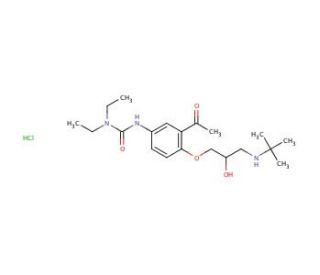

Estructura molecular de Celiprolol Hydrochloride, Número CAS: 57470-78-7
Celiprolol Hydrochloride (CAS 57470-78-7)
Ver las publicaciones del producto (3)
Nombres Alternativos:
1-{3-acetyl-4-[3-(tert-butylamino)-2-hydroxypropoxy]phenyl}-3,3-diethylurea hydrochloride
Solicitud:
Celiprolol Hydrochloride es un inhibidor β1-AR cardioselectivo
Número de CAS:
57470-78-7
Pureza:
≥95%
Peso Molecular:
415.95
Fórmula Molecular:
C20H33N3O4•HCl
Para Uso Exclusivo en Investigación. No está diseñado para uso en diagnosis o terapia.
* En el Certificado de Análisis específico de lote, puede encontrar información específica (como el contenido en agua).
ENLACES RÁPIDOS
Información sobre pedidos
Menciones del Producto
Descripción
Información Técnica
Información de Seguridad
SDS & Certificado de Análisis
Celiprolol Hydrochloride es un bloqueador beta1-AR (receptor adrenérgico) cardioselectivo que posee propiedades potencialmente antianginosa y antihipertensiva. Los adrenoreceptores, o receptores adrenérgicos, son proteínas acopladas a G involucradas en una variedad de actividades del sistema nervioso simpático. El beta1-AR está principalmente asociado con los efectos de salida cardíaca.
Celiprolol Hydrochloride (CAS 57470-78-7) Referencias
- El deterioro de la producción de óxido nítrico en las células endoteliales coronarias de la rata BB espontáneamente diabética se debe a la deficiencia de tetrahidrobiopterina. | Meininger, CJ., et al. 2000. Biochem J. 349: 353-6. PMID: 10861247
- El factor de necrosis tumoral-alfa suprime los genes específicos de los adipocitos y activa la expresión de genes preadipocitarios en los adipocitos 3T3-L1: la activación del factor nuclear-kappaB por el TNF-alfa es obligatoria. | Ruan, H., et al. 2002. Diabetes. 51: 1319-36. PMID: 11978627
- El celiprolol inhibe la proteína cinasa activada por mitógenos y el gen de la endotelina-1 y del factor de crecimiento transformante-beta(1) en ratas. | Tsubokou, Y., et al. 2002. Eur J Pharmacol. 457: 85-93. PMID: 12464353
- El celiprolol aumenta el flujo sanguíneo coronario y reduce la gravedad de la isquemia miocárdica mediante la liberación de óxido nítrico. | Asanuma, H., et al. 2003. J Cardiovasc Pharmacol. 41: 499-505. PMID: 12658050
- El celiprolol activa la eNOS a través de la vía PI3K-Akt e inhibe la VCAM-1 vía NF-kappaB inducida por el estrés oxidativo. | Kobayashi, N., et al. 2003. Hypertension. 42: 1004-13. PMID: 14557279
- El celiprolol, un betabloqueante vasodilatador, inhibe la hipertrofia cardiaca inducida por sobrecarga de presión y previene la transición a insuficiencia cardiaca mediante mecanismos dependientes del óxido nítrico en ratones. | Liao, Y., et al. 2004. Circulation. 110: 692-9. PMID: 15262839
- El celiprolol, un bloqueante beta1 selectivo, reduce el tamaño del infarto mediante la producción de óxido nítrico en un modelo de infarto de miocardio en conejos. | Chen, X., et al. 2007. Circ J. 71: 574-9. PMID: 17384462
- El celiprolol reduce el engrosamiento intimal de los injertos venosos autógenos mediante una mejora de la función del óxido nítrico a través de una inhibición de la producción de superóxido. | Hattori, K., et al. 2007. J Vasc Surg. 46: 116-23. PMID: 17606127
- El celiprolol induce la relajación dependiente de β(3)-adrenoceptores en arterias coronarias porcinas aisladas. | Abdelkrim, MA., et al. 2013. Can J Physiol Pharmacol. 91: 791-6. PMID: 24144049
- Efectos del celiprolol sobre las concentraciones séricas de citoquinas proinflamatorias en ratas hipertensas (SHR) y normotensas (WKY). | Andrzejczak, D. and Górska, D. 2014. Pharmacol Rep. 66: 68-73. PMID: 24905309
- Celiprolol: Un modulador adrenoceptor selectivo único. | Nawarskas, JJ., et al. 2017. Cardiol Rev. 25: 247-253. PMID: 28742547
- El celiprolol, pero no el losartán, mejora la integridad biomecánica de la aorta en un modelo de ratón del síndrome vascular de Ehlers-Danlos. | Dubacher, N., et al. 2020. Cardiovasc Res. 116: 457-465. PMID: 31056650
- Caracterización de los productos de degradación del clorhidrato de celiprolol mediante técnicas de masa hilada y RMN. | Sahu, A., et al. 2021. J Pharm Biomed Anal. 197: 113953. PMID: 33618130
- Farmacogenómica del celiprolol: pruebas del papel de la glicoproteína P y del polipéptido transportador de aniones orgánicos 1A2 en la farmacocinética del celiprolol. | Hirvensalo, P., et al. 2022. Clin Transl Sci. 15: 409-421. PMID: 34585840
Inhibidor de:
beta1-AR.Activador de:
DnaJA4, y TTP.Información sobre pedidos
| Nombre del producto | Número de catálogo | UNIDAD | Precio | CANTIDAD | Favoritos | |
Celiprolol Hydrochloride, 10 mg | sc-211051 | 10 mg | $360.00 | |||
Celiprolol Hydrochloride, 50 mg | sc-211051A | 50 mg | $990.00 |