
Date published: 2026-3-28

1-800-457-3801

SCBT Portrait Logo
Seach Input

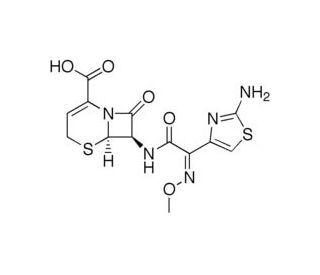
Ceftizoxime (CAS 68401-81-0)

0.0(0)
Write a reviewAsk a question

Application:
Ceftizoxime is a derivative of cephalosporin
CAS Number:
68401-81-0
Molecular Weight:
383.408
Molecular Formula:
C13H13N5O5S2
For Research Use Only. Not Intended for Diagnostic or Therapeutic Use.
* Refer to Certificate of Analysis for lot specific data.

QUICK LINKS

Ceftizoxime, a third-generation cephalosporin antibiotic, is widely used in microbiological research for its effective bactericidal action, specifically targeting a broad range of Gram-positive and Gram-negative bacteria. Its mechanism of action involves the inhibition of bacterial cell wall synthesis by binding to and inactivating penicillin-binding proteins (PBPs). These proteins are essential for maintaining the structural integrity of the bacterial cell wall; their inactivation leads to the disruption of cell wall synthesis, resulting in bacterial cell lysis. Ceftizoxime is particularly valued in research settings for its stability against beta-lactamases, enzymes produced by bacteria that degrade many other beta-lactam antibiotics. This property makes it an excellent tool for studying antibiotic resistance mechanisms, especially in pathogens that express extended-spectrum beta-lactamases (ESBLs). Additionally, Ceftizoxime′s ability to penetrate bacterial cells efficiently allows for detailed studies on the kinetics and dynamics of antibiotic action within different bacterial populations. Researchers also utilize this chemical to examine the interactions between antibiotics and bacterial membranes, providing insights into how structural modifications in cephalosporins affect their efficacy and resistance profiles. Through these applications, Ceftizoxime aids in advancing our understanding of microbial resistance, guiding the development of new strategies to combat infectious diseases in research environments.


Ceftizoxime (CAS 68401-81-0) References

  1. Coinfection of Clostridium perfringens and Escherichia coli in gas-producing perianal abscess diagnosed by 16S rDNA sequencing: a case report.  |  Sun, Y., et al. 2021. Gut Pathog. 13: 61. PMID: 34645489
  2. A retrospective study of azithromycin and ceftizoxime for the management of children with Mycoplasma pneumoniae pneumonia.  |  Han, LP., et al. 2021. Medicine (Baltimore). 100: e27564. PMID: 34871221
  3. Study of β-lactam-based drug interaction with albumin protein using optical, sensing, and docking methods.  |  Monirinasab, H., et al. 2022. J Biol Phys. 48: 177-194. PMID: 35094207
  4. Improved disk diffusion method for simple detection of group B streptococci with reduced penicillin susceptibility (PRGBS).  |  Goto, R., et al. 2023. Diagn Microbiol Infect Dis. 105: 115881. PMID: 36586277
  5. Whole-Genome Analysis of Antimicrobial-Resistant Salmonella enterica Isolated from Duck Carcasses in Hanoi, Vietnam.  |  Nguyen, TT., et al. 2023. Curr Issues Mol Biol. 45: 2213-2229. PMID: 36975513
  6. Deriving protein binding-corrected chemical concentrations for in vitro testing.  |  Kolli, AR. 2023. Clin Transl Sci. 16: 2123-2129. PMID: 37605430
  7. Dissemination of Class A Cephalosporinases and Class D Carbapenemases in Escherichia coli Isolates From a Tertiary Hospital in Sudan.  |  Khalid, KE. 2023. Cureus. 15: e44365. PMID: 37779806
  8. Molecular characteristics of Staphylococcus aureus strains isolated from subclinical mastitis of water buffaloes in Guangdong Province, China.  |  Zhang, D., et al. 2023. Front Vet Sci. 10: 1177302. PMID: 38026659
  9. β-Lactam Susceptibility of Streptococcus dysgalactiae subsp. equisimilis.  |  Nakashima, N., et al. 2024. Jpn J Infect Dis.. PMID: 38296542
  10. Susceptibility and Synergistic Effects of Guava Plant Extract and Antimicrobial Drugs on Escherichia coli.  |  Mitra, S., et al. 2024. Cureus. 16: e52345. PMID: 38361731

Ordering Information

Product NameCatalog #UNITPriceQtyFAVORITES

Ceftizoxime, 100 mg

sc-278825
100 mg
$300.00