
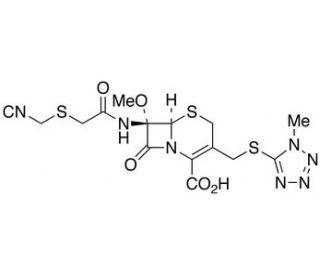

Cefmetazole (CAS 56796-20-4)
QUICK LINKS
Cefmetazole, cataloged under CAS number 56796-20-4, is a second-generation cephalosporin antibiotic notable for its broad-spectrum antibacterial activity, primarily employed in research focused on bacterial cell wall synthesis and antibiotic resistance mechanisms. The fundamental mechanism of action of Cefmetazole involves the inhibition of bacterial cell wall synthesis, specifically by targeting and binding to penicillin-binding proteins (PBPs) located on the bacterial cell wall. These proteins are crucial for the cross-linking process that gives bacterial cell walls their strength and rigidity. By binding to these PBPs, Cefmetazole blocks the transpeptidation or cross-linking step of cell wall biosynthesis, leading to the weakening of the cell wall and ultimately causing bacterial cell lysis and death. This specific interaction makes Cefmetazole a valuable tool in microbiological research, particularly in studies exploring the kinetics and dynamics of cell wall assembly in bacteria, as well as the genetic and biochemical bases of resistance to beta-lactam antibiotics. Research employing Cefmetazole has significantly contributed to understanding how mutations in PBPs or the production of beta-lactamases can confer resistance, providing insights that are crucial for the development of new strategies to combat bacterial infections in a research context.
Cefmetazole (CAS 56796-20-4) References
- Improved survival in mice with diet-induced pancreatitis treated with new potent protease inhibitor, E-3123 and a broad spectrum antibiotic, cefmetazole. | Hirano, T., et al. 1992. Nihon Geka Hokan. 61: 213-23. PMID: 1444701
- Humanization of excretory pathway in chimeric mice with humanized liver. | Okumura, H., et al. 2007. Toxicol Sci. 97: 533-8. PMID: 17341479
- Application of chimeric mice with humanized liver for predictive ADME. | Katoh, M. and Yokoi, T. 2007. Drug Metab Rev. 39: 145-57. PMID: 17364883
- Chimeric mice with humanized liver. | Katoh, M., et al. 2008. Toxicology. 246: 9-17. PMID: 18248870
- Influences of cephem antibiotics on the immune response in mice. | Akahane, K., et al. 1990. Chemotherapy. 36: 300-7. PMID: 2123769
- Attenuation of prostaglandin E2 elimination across the mouse blood-brain barrier in lipopolysaccharide-induced inflammation and additive inhibitory effect of cefmetazole. | Akanuma, S., et al. 2011. Fluids Barriers CNS. 8: 24. PMID: 22014165
- Chimeric TK-NOG mice: a predictive model for cholestatic human liver toxicity. | Xu, D., et al. 2015. J Pharmacol Exp Ther. 352: 274-80. PMID: 25424997
- Use of cephalosporins for prophylaxis and therapy of polymicrobial infection in mice. | Brook, I. 1993. Antimicrob Agents Chemother. 37: 1531-5. PMID: 8363386
- In-vitro susceptibility and in-vivo efficacy of antimicrobials in the treatment of intraabdominal sepsis in mice. | Brook, I. and Gillmore, JD. 1993. J Antimicrob Chemother. 31: 393-401. PMID: 8486573
Ordering Information
| Product Name | Catalog # | UNIT | Price | Qty | FAVORITES | |
Cefmetazole, 10 mg | sc-211041 | 10 mg | $220.00 |