
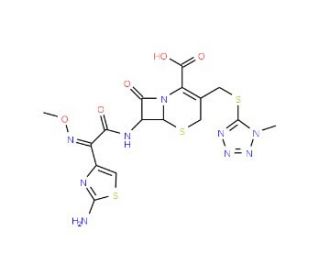

Cefmenoxime (CAS 65085-01-0)
Direktverknüpfungen
Cefmenoxim, ein Cephalosporin-Antibiotikum der dritten Generation, ist aufgrund seiner starken antimikrobiellen Aktivität und seiner einzigartigen Wirkungsweise gegen ein breites Spektrum bakterieller Krankheitserreger zu einem Gegenstand von großem Interesse in der wissenschaftlichen Forschung geworden. Die bakterientötende Wirkung dieses Wirkstoffs beruht auf der Hemmung der bakteriellen Zellwandsynthese durch Bindung an Penicillin-bindende Proteine (PBP), insbesondere PBP-3, was zu einer Unterbrechung der Peptidoglykan-Vernetzung und anschließender Zelllyse führt. Die Forschung zu Cefmenoxim hat sich in erster Linie auf die Aufklärung seines antimikrobiellen Spektrums konzentriert, einschließlich seiner Wirksamkeit gegen multiresistente Bakterienstämme wie ESBL-produzierende Enterobacteriaceae und Methicillin-resistente Staphylococcus aureus (MRSA). Darüber hinaus wurden die pharmakokinetischen Eigenschaften von Cefmenoxim, einschließlich Absorption, Verteilung, Metabolismus und Ausscheidung, erforscht, um die Dosierung und die Ergebnisse zu optimieren. Darüber hinaus wurden in Studien die potenziellen synergistischen Wechselwirkungen von Cefmenoxim mit anderen antimikrobiellen Wirkstoffen untersucht, um seine Wirksamkeit zu erhöhen und aufkommende Antibiotikaresistenzen zu bekämpfen. Darüber hinaus zielen die laufenden Forschungsbemühungen auf die Entwicklung neuartiger Formulierungen und Verabreichungssysteme für Cefmenoxim ab, um seine Bioverfügbarkeit und Gewebepenetration zu verbessern und damit sein Potenzial bei der Behandlung von Infektionskrankheiten zu maximieren. Insgesamt ist Cefmenoxim ein wertvolles Instrument für die Forschung, die darauf abzielt, die bakterielle Pathogenese und die Mechanismen der Antibiotikaresistenz zu verstehen und innovative Strategien zu entwickeln.
Cefmenoxime (CAS 65085-01-0) Literaturhinweise
- Fall einer spät einsetzenden, mit einer Bleb-assoziierten Endophthalmitis, verursacht durch Rothia mucilaginosa. | Oie, S., et al. 2016. J Infect Chemother. 22: 645-7. PMID: 27008920
- Eine Superinfektion der Hornhaut durch Stemphylium, Acremonium und α-Streptococcus. | Hotta, F., et al. 2017. Ann Clin Microbiol Antimicrob. 16: 11. PMID: 28279173
- Bakterienflora der Bindehaut von Glaukompatienten während der Langzeitverabreichung von Prostaglandin-Analog-Tropfen. | Ohtani, S., et al. 2017. Invest Ophthalmol Vis Sci. 58: 3991-3996. PMID: 28796877
- Trennung und Charakterisierung von allergischen polymerisierten Verunreinigungen in Cephalosporinen durch 2D-HPSEC×LC-IT-TOF MS. | Xu, Y., et al. 2017. J Pharm Biomed Anal. 145: 742-750. PMID: 28806571
- Moraxella-Arten: Infektiöse Mikroben, die mithilfe der Flugzeit-Massenspektrometrie identifiziert wurden. | Takahashi, S., et al. 2019. Jpn J Ophthalmol. 63: 328-336. PMID: 31273564
- Brachybacterium paraconglomeratum-Endophthalmitis nach Kataraktoperation. | Murata, K., et al. 2020. Case Rep Ophthalmol Med. 2020: 1513069. PMID: 32231828
- Bakterielle Flora der Bindehaut und Empfindlichkeit gegenüber antimikrobiellen Mitteln bei bakteriellen Krankheitserregern, die vor einer Kataraktoperation isoliert wurden. | Matsuura, K., et al. 2020. Jpn J Ophthalmol. 64: 423-428. PMID: 32458168
- Escherichia coli Panophthalmitis nach dem Picken durch einen Silberreiher (Ardea alba). | Ono, T., et al. 2020. Case Rep Ophthalmol. 11: 466-472. PMID: 32999677
- Übersicht über die Verneblertherapie bei entzündlichen Erkrankungen der Nase in Japan vor und während der COVID-19-Pandemie. | Hyo, Y., et al. 2022. Auris Nasus Larynx. 49: 504-510. PMID: 34865941
- Blepharokeratokonjunktivitis, vermutlich verursacht durch Paederus fuscipes, einen Käfer: Ein Fallbericht. | Ono, T., et al. 2023. Case Rep Ophthalmol. 14: 555-561. PMID: 37901643
Bestellinformation
| Produkt | Katalog # | EINHEIT | Preis | ANZAHL | Favoriten | |
Cefmenoxime, 10 mg | sc-278817 | 10 mg | $700.00 |