
Date published: 2025-12-18

1-800-457-3801

SCBT Portrait Logo
Seach Input

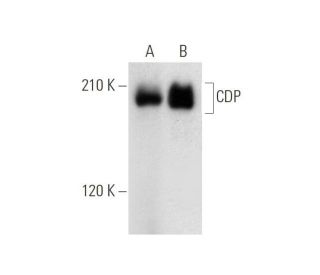
CUTL1/CUX1/CDP Antibody (B-10): sc-514008

2.7(19)
Write a reviewAsk a question

Datasheets
  • CUTL1/CUX1/CDP Antibody (B-10) is a mouse monoclonal IgG3 κ CUTL1/CUX1/CDP antibody, cited in 22 publications, provided at 200 µg/ml
  • specific for an epitope mapping between amino acids 1308-1332 at the C-terminus of CDP of mouse origin
  • recommended for detection of CDP of mouse, rat and human origin by WB, IP, IF, IHC(P) and ELISA
  • available conjugated to agarose for IP; HRP for WB, IHC(P) and ELISA; phycoerythrin, FITC, Alexa Fluor® 488 or Alexa Fluor® 647 for IF, IHC(P) and FCM
  • TransCruz reagent for ChIP application (sc-514008 X, 200 µg/0.1 ml)
  • m-IgG3 BP-HRP is the preferred secondary detection reagent for CUTL1/CUX1/CDP Antibody (B-10) for WB and IHC(P) applications. This reagent is now offered in a bundle with CUTL1/CUX1/CDP Antibody (B-10) (see ordering information below).

QUICK LINKS

SEE ALSO...

CDP Antibody (B-10) is a mouse monoclonal IgG3 kappa light chain antibody designed to recognize the CCAAT displacement protein (CDP), also known as CUX1 or CUTL1, with an epitope mapping between amino acids 1308-1332 at the C-terminus of the mouse CDP protein. CDP monoclonal antibody (B-10) exhibits broad species reactivity, effectively detecting CDP from mouse, rat, and human origins through various applications including western blotting (WB), immunoprecipitation (IP), immunofluorescence (IF), immunohistochemistry with paraffin-embedded sections (IHCP), and enzyme-linked immunosorbent assay (ELISA). Available in both non-conjugated form and multiple conjugated forms such as agarose, horseradish peroxidase (HRP), phycoerythrin (PE), fluorescein isothiocyanate (FITC), and various Alexa Fluor® conjugates, anti-CDP antibody (B-10) provides versatile options for researchers. CDP, also called ASP, CDP/Cut, CDP1, COY1, CUTL1, CUX, Clox, Cux/CDP, GDDI, and GOLIM6, is a crucial homeodomain-containing transcriptional repressor located predominantly in the nucleus, where CDP regulates the transcription of developmentally controlled genes by competing with transcriptional activators for binding to promoter regions. This localization is essential for CDP′s role in modulating gene expression and maintaining proper cellular function. CDP contains three cut repeats that serve as DNA binding domains, enabling CDP to interact with DNA both independently and in conjunction with its homeodomain. Additionally, CDP is a key component of the HiNF-D complex, which includes cyclin A, Cdc2, and an Rb-related protein. This complex is vital for the regulation of histone gene transcription, specifically histones H4, H3, and H1, which are necessary for chromatin assembly and the progression of cells from the G1 phase to the S phase of the cell cycle. By controlling histone expression, CDP plays an integral role in ensuring genomic integrity and facilitating proper cell division. CDP monoclonal antibody (B-10)′s ability to reliably detect CDP across multiple species and experimental platforms makes this product an indispensable tool for researchers studying gene regulation, cell cycle dynamics, and the molecular mechanisms underlying development and various diseases.

For Research Use Only. Not Intended for Diagnostic or Therapeutic Use.

Alexa Fluor® is a trademark of Molecular Probes Inc., OR., USA

LI-COR® and Odyssey® are registered trademarks of LI-COR Biosciences

CUTL1/CUX1/CDP Antibody (B-10) References:

  1. Human CCAAT displacement protein is homologous to the Drosophila homeoprotein, cut.  |  Neufeld, EJ., et al. 1992. Nat Genet. 1: 50-5. PMID: 1301999
  2. Antagonistic regulation of the Drosophila PCNA gene promoter by DREF and Cut.  |  Seto, H., et al. 2006. Genes Cells. 11: 499-512. PMID: 16629902
  3. Differentiation-induced cleavage of Cutl1/CDP generates a novel dominant-negative isoform that regulates mammary gene expression.  |  Maitra, U., et al. 2006. Mol Cell Biol. 26: 7466-78. PMID: 17015474
  4. Transgenic mice expressing the p75 CCAAT-displacement protein/Cut homeobox isoform develop a myeloproliferative disease-like myeloid leukemia.  |  Cadieux, C., et al. 2006. Cancer Res. 66: 9492-501. PMID: 17018605
  5. Conserved cut repeats in the human cut homeodomain protein function as DNA binding domains.  |  Harada, R., et al. 1994. J Biol Chem. 269: 2062-7. PMID: 7904999
  6. The mouse homeodomain protein Phox2 regulates Ncam promoter activity in concert with Cux/CDP and is a putative determinant of neurotransmitter phenotype.  |  Valarché, I., et al. 1993. Development. 119: 881-96. PMID: 7910552
  7. CCAAT displacement protein competes with multiple transcriptional activators for binding to four sites in the proximal gp91phox promoter.  |  Luo, W. and Skalnik, DG. 1996. J Biol Chem. 271: 18203-10. PMID: 8663528
  8. CDP/cut is the DNA-binding subunit of histone gene transcription factor HiNF-D: a mechanism for gene regulation at the G1/S phase cell cycle transition point independent of transcription factor E2F.  |  van Wijnen, AJ., et al. 1996. Proc Natl Acad Sci U S A. 93: 11516-21. PMID: 8876167

Ordering Information

Product NameCatalog #UNITPriceQtyFAVORITES

CUTL1/CUX1/CDP Antibody (B-10)

sc-514008
200 µg/ml
$316.00

CUTL1/CUX1/CDP Antibody (B-10): m-IgG3 BP-HRP Bundle

sc-550607
200 µg Ab; 40 µg BP
$354.00

CUTL1/CUX1/CDP Antibody (B-10) AC

sc-514008 AC
500 µg/ml, 25% agarose
$416.00

CUTL1/CUX1/CDP Antibody (B-10) Alexa Fluor® 488

sc-514008 AF488
200 µg/ml
$357.00

CUTL1/CUX1/CDP Antibody (B-10) Alexa Fluor® 647

sc-514008 AF647
200 µg/ml
$357.00

CUTL1/CUX1/CDP Antibody (B-10) FITC

sc-514008 FITC
200 µg/ml
$330.00

CUTL1/CUX1/CDP Antibody (B-10) HRP

sc-514008 HRP
200 µg/ml
$316.00

CUTL1/CUX1/CDP (B-10) Neutralizing Peptide

sc-514008 P
100 µg/0.5 ml
$68.00

CUTL1/CUX1/CDP Antibody (B-10) PE

sc-514008 PE
200 µg/ml
$343.00

CUTL1/CUX1/CDP Antibody (B-10) X

sc-514008 X
200 µg/0.1 ml
$316.00

Hi, I used this antibody for my whole mount brain imaging with the technique called iDISCO, and I saw good staining. I saw the signal of Cux1 is mainly in the cytosol instead of the nucleus, which is suggested by the literatures. 

Asked by: Anonymous
Thank you for your question. It would be helpful if you could call us directly at 800-457-3801 ext 1, allowing for a more interactive discussion of this and other related questions.
Answered by: Blake J
Date published: 2021-08-11

Hello, I am interested in ordering this antibody for IP. I have some literature citing old polyclonal Ab for IP with great success but the reviews on this monoclonal are worrisome. Also, I am interested in using magnetic beads for labeling. Please advice.

Asked by: sbagla
Thank you for your question. This antibody has been established for IP applications in samples of mouse, rat and human origin in our labs and offer our warranty for this use. If you purchase the antibody and it does not perform as expected in the recommended species and application, please contact our Technical Service Department. If we are unable to help you troubleshoot the antibody, we can provide you with a complimentary replacement antibody, credit or refund. Our warranty is for one year from the date of purchase.
Answered by: Tech Support Europe
Date published: 2019-06-12

Hi there! I've been looking at the wonderful IHC images obtained with the CDP M-222 antibody; however, I'm concerned with the bad reviews of its replacement. I want to use CDP B-10 for PFA fixed free floating mouse brain sections.

Asked by: JuanSA
Thank you for your question. We have not tested this antibody in free floating mouse brain tissue sections. However, we have had excellent results using the antibody in formalin-fixed paraffin-embedded human thyroid and upper stomach tissues. Unlike in some of the customer product reviews, we used the primary antibody at a dilution of 1:50. We do warranty the antibody to work for mouse tissues. If you purchase the antibody and it does not perform as expected in the recommended species and application, please contact our Technical Service Department. If we are unable to help you troubleshoot the antibody, we can provide you with a complimentary replacement antibody, credit or refund. Our warranty is for one year from the date of purchase.
Answered by: Technical Support
Date published: 2018-11-21

What application is the blocking peptide sc-514008 P appropriate for?

Asked by: jenniferc
Thank you for your question. The blocking peptide is intended for use as a negative control, by pre-adsorbing the mouse monoclonal antibody against the antigen. For full protocol details, please contact our Technical Services Department or view our online protocol here: https://www.scbt.com/scbt/resources/protocols/peptide-neutralization
Answered by: Technical Support 7
Date published: 2017-01-22
  • y_2025, m_12, d_13, h_9CST
  • bvseo_bulk, prod_bvqa, vn_bulk_3.0.42
  • cp_1, bvpage1
  • co_hasquestionsanswers, tq_4
  • loc_en_US, sid_514008, prod, sort_[SortEntry(order=LAST_APPROVED_ANSWER_SUBMISSION_TIME, direction=DESCENDING)]
  • clientName_scbt
  • bvseo_sdk, java_sdk, bvseo-4.0.0
  • CLOUD, getContent, 106ms
  • QUESTIONS, PRODUCT
Rated 5 out of 5 by from Good antibodyThe antibody arrived quickly. It works well for immunostaining
Date published: 2025-07-07
Rated 1 out of 5 by from No signal at allWe tested this antibody on mouse embryonic brain tissue to stain neocortical upper layers. No signal at all with or without antigen retrieval. It's a shame that M222 antibody was replaced by this one.
Date published: 2020-03-04
Rated 1 out of 5 by from Didn't WorkOur lab has previously used and gotten great results from the SCBT's discontinued polyclonal CDP ab. We purchased the monoclonal since the poly was no longer available, but it did not work. Despite multiple attempts with and without antigen retrieval from two different lot numbers of the antibody, we got no results. SCBT has, however, been extremely helpful in terms of providing a second aliquot of no charge. They responded quickly and we are very happy with their customer service.
Date published: 2019-04-16
Rated 1 out of 5 by from Did not work for mouse brain IHCWe tested this antibody in free floating sections of perfused mouse brain. No specific signal was observed at a 1:100 dilution. Antigen retrieval with citrate buffer pH 6.0 at 85°C for 25 min also failed to produce any specific staining.
Date published: 2018-11-15
Rated 1 out of 5 by from No bands were observed in WBUsed 1:100 dilution for mouse tissue (Liver, brain) as well as AML12 hepatocyte cell line nuclear and cytoplasmic proteins for 1 overnight incubation in 5% milk TBS-T blocking buffer. No bands whatsoever was observed. Actin and Nucleolin band as loading control was very good, so it was not the protein problem. As well, same secondary Ab was used for the Actin that was used with this Ab, so it was not the secondary antibody issue either.
Date published: 2018-03-20
Rated 1 out of 5 by from That's too bad..I got the sample of this and tried. No matter how I tried to stain with this antibody, there's only very blurred signal on the sections
Date published: 2018-02-26
Rated 1 out of 5 by from Did not work for IFTried it for IF on mouse brain slices (1:500) and it did not work
Date published: 2018-01-30
Rated 5 out of 5 by from niceGreat antibody!1:1000 used in the u251 cells by Western Blotting, I got satisfactory results.
Date published: 2017-11-03
  • y_2025, m_12, d_13, h_9
  • bvseo_bulk, prod_bvrr, vn_bulk_3.0.42
  • cp_1, bvpage1
  • co_hasreviews, tv_0, tr_19
  • loc_en_US, sid_514008, prod, sort_[SortEntry(order=SUBMISSION_TIME, direction=DESCENDING)]
  • clientName_scbt
  • bvseo_sdk, java_sdk, bvseo-4.0.0
  • CLOUD, getReviews, 15ms
  • REVIEWS, PRODUCT
CUTL1/CUX1/CDP Antibody (B-10) is rated 2.7 out of 5 by 19.
  • y_2025, m_12, d_13, h_9
  • bvseo_bulk, prod_bvrr, vn_bulk_3.0.42
  • cp_1, bvpage1
  • co_hasreviews, tv_0, tr_19
  • loc_en_US, sid_514008, prod, sort_[SortEntry(order=SUBMISSION_TIME, direction=DESCENDING)]
  • clientName_scbt
  • bvseo_sdk, java_sdk, bvseo-4.0.0
  • CLOUD, getAggregateRating, 109ms
  • REVIEWS, PRODUCT