
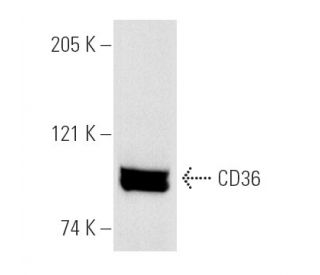
CD36 Antibody (SMφ): sc-7309
- CD36 Antibody (SMφ) is a mouse monoclonal IgM κ CD36 antibody, cited in 101 publications, provided at 200 µg/ml
- raised against human tonsil cells and peripheral blood monocytes
- recommended for detection of CD36 of mouse, rat and human origin by WB, IP, IF, IHC(P) and FCM
- available conjugated to agarose for IP; HRP for WB, IHC(P) and ELISA; phycoerythrin, FITC, Alexa Fluor® 488 or Alexa Fluor® 647 for IF, IHC(P) and FCM
- CD36 Antibody (SMφ) is available conjugated to Alexa Fluor® 594 for IF, IHC(P) and FCM
- At present, we have not yet completed the identification of the preferred secondary detection reagent(s) for CD36 Antibody (SMφ). This work is in progress.

QUICK LINKS
SEE ALSO...
CD36 Antibody (SMφ) is a mouse monoclonal IgM kappa light chain antibody specifically developed to recognize CD36, also known as platelet glycoprotein 4 (GPIV), fatty acid translocase (FAT), glycoprotein IIIb (GPIIIB), scavenger receptor class B member 3 (SCARB3), and PAS IV. CD36 is a multifunctional membrane glycoprotein prominently located on the surface of platelets, monocytes, and umbilical vein endothelial cells. This strategic cellular localization enables CD36 to interact with a variety of ligands, including collagen, thrombospondin, anionic phospholipids, and oxidized low-density lipoproteins (LDL), facilitating crucial processes such as phagocytosis and lipid metabolism. CD36 mediates interactions essential for maintaining cellular homeostasis, supporting the continuous production of mature spermatozoa, and regulating inflammatory responses. CD36 plays a significant role in cell adhesion, influencing adhesive processes vital for tissue integrity and repair. Mutations in CD36 can lead to platelet glycoprotein deficiency, highlighting CD36′s importance in normal platelet function and hemostasis. Anti-CD36 antibody (SMφ) demonstrates reactivity across mouse, rat, and human species, making CD36 (SMφ) antibody a versatile tool for various experimental applications including western blotting (WB), immunoprecipitation (IP), immunofluorescence (IF), immunohistochemistry with paraffin-embedded sections (IHCP), and flow cytometry (FCM). CD36 monoclonal antibody (SMφ) supports advanced research into CD36′s diverse roles in cardiovascular diseases, metabolic disorders, and immune system regulation, thereby providing invaluable insights into both physiological and pathological mechanisms.
Alexa Fluor® is a trademark of Molecular Probes Inc., OR., USA
LI-COR® and Odyssey® are registered trademarks of LI-COR Biosciences
CD36 Antibody (SMφ) References:
- Membrane glycoprotein CD36: a review of its roles in adherence, signal transduction, and transfusion medicine. | Greenwalt, DE., et al. 1992. Blood. 80: 1105-15. PMID: 1381234
- Macrophage chemotaxis to apoptotic Burkitt's lymphoma cells in vitro: role of CD14 and CD36. | Truman, LA., et al. 2004. Immunobiology. 209: 21-30. PMID: 15481137
- FAT/CD36-mediated long-chain fatty acid uptake in adipocytes requires plasma membrane rafts. | Pohl, J., et al. 2005. Mol Biol Cell. 16: 24-31. PMID: 15496455
- Advanced glycation end products-modified proteins and oxidized LDL mediate down-regulation of leptin in mouse adipocytes via CD36. | Unno, Y., et al. 2004. Biochem Biophys Res Commun. 325: 151-6. PMID: 15522213
- CD36 is a sensor of diacylglycerides. | Hoebe, K., et al. 2005. Nature. 433: 523-7. PMID: 15690042
- FoxO1 stimulates fatty acid uptake and oxidation in muscle cells through CD36-dependent and -independent mechanisms. | Bastie, CC., et al. 2005. J Biol Chem. 280: 14222-9. PMID: 15691844
- Collagen induces normal signal transduction in platelets deficient in CD36 (platelet glycoprotein IV). | Daniel, JL., et al. 1994. Thromb Haemost. 71: 353-6. PMID: 7518098
- Synthesis, processing, and intracellular transport of CD36 during monocytic differentiation. | Alessio, M., et al. 1996. J Biol Chem. 271: 1770-5. PMID: 8576181
- Identification of a domain (155-183) on CD36 implicated in the phagocytosis of apoptotic neutrophils. | Navazo, MD., et al. 1996. J Biol Chem. 271: 15381-5. PMID: 8663130
- CD36 mediates the In vitro inhibitory effects of thrombospondin-1 on endothelial cells. | Dawson, DW., et al. 1997. J Cell Biol. 138: 707-17. PMID: 9245797
Ordering Information
| Product Name | Catalog # | UNIT | Price | Qty | FAVORITES | |
CD36 Antibody (SMφ) | sc-7309 | 200 µg/ml | $322.00 | |||
CD36 Antibody (SMΦ) AC | sc-7309 AC | 500 µg/ml, 25% agarose | $424.00 | |||
CD36 Antibody (SMΦ) Alexa Fluor® 488 | sc-7309 AF488 | 200 µg/ml | $364.00 | |||
CD36 Antibody (SMΦ) Alexa Fluor® 594 | sc-7309 AF594 | 200 µg/ml | $364.00 | |||
CD36 Antibody (SMΦ) Alexa Fluor® 647 | sc-7309 AF647 | 200 µg/ml | $364.00 | |||
CD36 Antibody (SMΦ) FITC | sc-7309 FITC | 200 µg/ml | $336.00 | |||
CD36 Antibody (SMΦ) HRP | sc-7309 HRP | 200 µg/ml | $322.00 | |||
CD36 Antibody (SMΦ) PE | sc-7309 PE | 200 µg/ml | $349.00 |