
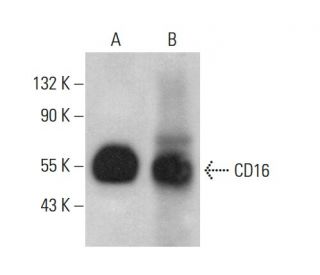
Not CRISPR data: the image illustrates antibody quality for visualizing CRISPR experiment results.
Not CRISPR data: the image illustrates antibody quality for visualizing CRISPR experiment results.
CD16 Double Nickase Plasmid (h): sc-400544-NIC
- Target species: human
- 20 µg of transfection-ready, purified plasmid DNA; Suitable for up to 20 transfections
- CD16 Double Nickase Plasmid (h) consists of a pair of plasmids each encoding a D10A mutated Cas9 nuclease and a target-specific 20 nt guide RNA (gRNA) designed to knockout gene expression with greater specificity than its CRISPR/Cas9 KO counterpart
- Paired gRNA sequences are offset by approximately 20 bp to allow for specific Cas9-mediated double nicking of the genomic DNA, which mimics a DSB
- One plasmid in the pair contains a puromycin-resistance gene for selection; the other plasmid in the pair contains a GFP marker to visually confirm transfection
- CD16 Double Nickase Plasmid (h) and CD16 Double Nickase Plasmid (h2) encode distinct paired gRNA designs targeting FCGR3A. One or both designs may be available
- Following transfection, gene knockout efficiency can be assayed by WB, IF or IHC using antibody: CD16 Antibody (DJ130c): sc-20052

Ordering Information
| Product Name | Catalog # | UNIT | Price | Qty | FAVORITES | |
CD16 Double Nickase Plasmid (h) | sc-400544-NIC | 20 µg | $410.00 | |||
CD16 Double Nickase Plasmid (h2) | sc-400544-NIC-2 | 20 µg | $410.00 |
FCGR3A encodes CD16 (FcγRIIIa), a low-affinity receptor for IgG Fc that is prominently expressed on natural killer cells, monocytes, and macrophages, where it couples antibody recognition to cellular effector functions. CD16 signals through FcRγ and CD3ζ adaptor chains containing ITAM motifs to activate Src-family kinases, SYK/ZAP70 pathways, calcium flux, and downstream MAPK and NF-κB programs that regulate degranulation, cytokine release, and antibody-dependent cellular cytotoxicity. Genetic variation and altered expression of FCGR3A influence immune complex handling and inflammatory set points, linking this axis to autoimmunity and immune dysregulation. CD16 biology is also central to studies of innate immune activation, myeloid cell polarization, and antibody-mediated responses in oncology and infectious disease models.
CD16 Double Nickase Plasmid (h) consists of a matched pair of plasmids engineered for high-specificity editing of the FCGR3A locus in human cell lines. Each plasmid expresses a Cas9 D10A nickase and a distinct sgRNA targeting opposite DNA strands within FCGR3A. When directed to adjacent sites on opposite DNA strands, the two nickases generate offset single-strand nicks that together produce a staggered double-strand break, requiring coordinated on-target activity from both guides. The resulting DNA break is resolved by endogenous cellular repair pathways, most commonly through non-homologous end joining (NHEJ), leading to insertions or deletions that disrupt FCGR3A function. By requiring dual sgRNA engagement at the target locus, the double nicking approach enhances editing specificity and provides a complementary CRISPR strategy for applications where additional control over targeting precision is desired.
To support efficient identification of edited cells, one plasmid encodes GFP for fluorescent visualization of transfected populations, while the companion plasmid carries a puromycin resistance gene for antibiotic selection. Together, these features support efficient enrichment of co-transfected populations and simplify the validation of FCGR3A-disrupted clones.
For Research Use Only. Not Intended for Diagnostic or Therapeutic Use.