
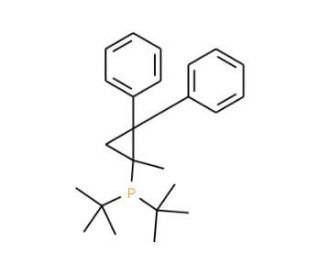

cBRIDP (CAS 742103-27-1)
QUICK LINKS
cBRIDP is a specialized chemical and may be used predominantly in catalytic processes and as a ligand in coordination chemistry. Its structure is designed to facilitate complex formation with various metals, enhancing catalytic activities in a range of chemical reactions, including synthesis and polymerization processes. The utility of cBRIDP in catalysis stems from its ability to stabilize metal centers and modulate their reactivity. This makes it an important component in the development of new catalytic systems that are more efficient and selective. Additionally, its role in forming stable complexes with metals helps in the study of reaction mechanisms and the development of novel synthetic pathways. The precise design and functionalization of cBRIDP allow it to be tailored for specific reactions, contributing to advancements in both industrial and academic research applications.
cBRIDP (CAS 742103-27-1) References
- Ligand-controlled access to [4 + 2] and [4 + 3] cycloadditions in gold-catalyzed reactions of allene-dienes. | Mauleón, P., et al. 2009. J Am Chem Soc. 131: 6348-9. PMID: 19378998
- TPGS-750-M: a second-generation amphiphile for metal-catalyzed cross-couplings in water at room temperature. | Lipshutz, BH., et al. 2011. J Org Chem. 76: 4379-91. PMID: 21548658
- Aminations of Aryl Bromides in Water at Room Temperature. | Lipshutz, BH., et al. 2009. Adv Synth Catal. 351: 1717-1721. PMID: 21804786
- 'Designer'-Surfactant-Enabled Cross-Couplings in Water at Room Temperature. | Lipshutz, BH. and Ghorai, S. 2012. Aldrichimica Acta. 45: 3-16. PMID: 23807816
- 'Nok': a phytosterol-based amphiphile enabling transition-metal-catalyzed couplings in water at room temperature. | Klumphu, P. and Lipshutz, BH. 2014. J Org Chem. 79: 888-900. PMID: 24447127
- Installation of protected ammonia equivalents onto aromatic & heteroaromatic rings in water enabled by micellar catalysis. | Isley, NA., et al. 2014. Green Chem. 16: 1480-1488. PMID: 25018667
- Uncovering Subtle Ligand Effects of Phosphines Using Gold(I) Catalysis. | Christian, AH., et al. 2017. ACS Catal. 7: 3973-3978. PMID: 29686935
- ppm Pd-catalyzed, Cu-free Sonogashira couplings in water using commercially available catalyst precursors. | Jin, B., et al. 2019. Chem Sci. 10: 3481-3485. PMID: 30996938
- Bridging the gap between transition metal- and bio-catalysis via aqueous micellar catalysis. | Cortes-Clerget, M., et al. 2019. Nat Commun. 10: 2169. PMID: 31092815
- One-Pot Synthesis of Chiral N-Arylamines by Combining Biocatalytic Aminations with Buchwald-Hartwig N-Arylation. | Cosgrove, SC., et al. 2020. Angew Chem Int Ed Engl. 59: 18156-18160. PMID: 32628797
- The Potential of Micellar Media in the Synthesis of DNA-Encoded Libraries. | Adamik, R., et al. 2022. Chemistry. 28: e202103967. PMID: 35019168
- Palladium Nanoparticles from Desulfovibrio alaskensis G20 Catalyze Biocompatible Sonogashira and Biohydrogenation Cascades. | Era, Y., et al. 2022. JACS Au. 2: 2446-2452. PMID: 36465541
- A sustainable, efficient, and potentially cost-effective approach to the antimalarial drug candidate MMV688533. | Kavthe, RD., et al. 2023. Chem Sci. 14: 6399-6407. PMID: 37325157
Ordering Information
| Product Name | Catalog # | UNIT | Price | Qty | FAVORITES | |
cBRIDP, 100 mg | sc-300329 | 100 mg | $36.00 |