
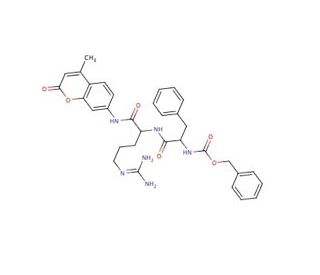

Cathepsin L substrate Substrato (CAS 65147-22-0)
Veja citações de produtos (11)
LINKS RÁPIDOS
O substrato de catepsina L é uma molécula especializada concebida para utilização em ensaios bioquímicos para estudar a atividade proteolítica da catepsina L, uma enzima implicada nos processos de degradação das proteínas. Na investigação, estes substratos são vitais para elucidar os mecanismos de degradação e renovação lisossómica, bem como para compreender a especificidade e a cinética da enzima. Os cientistas utilizam substratos marcados com fluorescência ou cromogénicos para monitorizar a atividade da catepsina L em tempo real, fornecendo informações sobre o papel desta enzima em funções celulares normais e em condições patológicas associadas à sua desregulação. Além disso, estes substratos estão no rastreio de potenciais inibidores que podem modular a atividade da catepsina L, uma área de interesse para o desenvolvimento de sondas químicas utilizadas para dissecar vias biológicas complexas. A conceção e a síntese destes substratos incorporam frequentemente sequências peptídicas reconhecidas e clivadas pela catepsina L, permitindo aos investigadores estudar o impacto das modificações pós-traducionais e o comportamento da enzima em várias condições experimentais.
Cathepsin L substrate Substrato (CAS 65147-22-0) Referencias
- A atividade da catepsina S é detetável nos queratinócitos humanos e é seletivamente regulada para cima após estimulação com interferão-gama. | Schwarz, G., et al. 2002. J Invest Dermatol. 119: 44-9. PMID: 12164923
- Caracterização de HC58cDNA, uma cisteína protease putativa do parasita Haemonchus contortus. | Muleke, CI., et al. 2006. J Vet Sci. 7: 249-55. PMID: 16871019
- Actividades de cisteíno-proteases do tipo catepsina B e L durante o desenvolvimento in vitro de Hysterothylacium aduncum (Nematoda: Anisakidae), um parasita de peixes a nível mundial. | Malagón, D., et al. 2010. Parasitol Int. 59: 89-92. PMID: 19932193
- A atividade de cisteína endoprotease da proteína ribossómica humana S4 é inteiramente devida ao domínio C-terminal e é consistente com o mecanismo de Michaelis-Menten. | Sudhamalla, B., et al. 2013. Biochim Biophys Acta. 1830: 5342-9. PMID: 23791938
- A apolipoproteína B-100 das lipoproteínas de baixa densidade do plasma sofre proteólise por factores de ativação de contacto quando o plasma é tratado com sulfato de dextrano-500-MgCl2. | Byrne, RE. and Scanu, AM. 1989. J Lipid Res. 30: 109-20. PMID: 2465366
- Identificação da catepsina B da corvina amarela grande (Pseudosciaena crocea) e seu papel no processamento da cadeia invariante associada ao MHC de classe II. | Li, M., et al. 2014. Dev Comp Immunol. 45: 313-20. PMID: 24705226
- Aumento da expressão e da atividade enzimática da cisteína proteinase B durante a diferenciação in vitro de Leishmania (Viannia) braziliensis: Primeira evidência de modulação durante a transição morfológica. | Gomes, CB., et al. 2017. Biochimie. 133: 28-36. PMID: 27919786
- Identificação e características de uma cisteína protease do tipo catepsina L de Clonorchis sinensis. | Ma, C., et al. 2019. Parasitol Res. 118: 829-835. PMID: 30689051
- A clivagem diferencial de substratos específicos para uma atividade semelhante à da catepsina revela actividades de cisteína e serina protease e um perfil diferencial entre Anisakis simplex s.s. e Anisakis pegreffii, espécies irmãs que são os principais agentes etiológicos da anisakiose. | Torralbo-Ramírez, V., et al. 2019. Foodborne Pathog Dis. 16: 744-751. PMID: 31215796
- Perfis de serino-proteases de isolados clínicos de Leishmania (Viannia) braziliensis com susceptibilidades distintas ao antimónio. | Zabala-Peñafiel, A., et al. 2021. Sci Rep. 11: 14234. PMID: 34244581
- O fator de tráfico de enzimas lisossomais LYSET permite a utilização nutricional de proteínas extracelulares. | Pechincha, C., et al. 2022. Science. 378: eabn5637. PMID: 36074822
- Secreção de atividade de cisteína proteinase pelo ancilóstomo zoonótico Ancylostoma caninum. | Dowd, AJ., et al. 1994. Am J Trop Med Hyg. 51: 341-7. PMID: 7943555
- Catepsina B de Schistosoma mansoni. Purificação e ativação da proenzima recombinante segregada por Saccharomyces cerevisiae. | Lipps, G., et al. 1996. J Biol Chem. 271: 1717-25. PMID: 8576174
Informacoes sobre ordens
| Nome do Produto | Numero de Catalogo | UNID | Preco | Qde | FAVORITOS | |
Cathepsin L substrate, 5 mg | sc-3136A | 5 mg | $102.00 | |||
Cathepsin L substrate, 25 mg | sc-3136 | 25 mg | $265.00 | |||
Cathepsin L substrate, 100 mg | sc-3136B | 100 mg | $708.00 |