
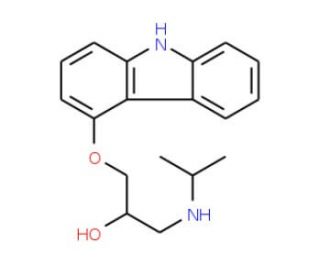

Carazolol (CAS 57775-29-8)
QUICK LINKS
The exocyst complex is a multi-protein complex essential for targeting and tethering vesicles to specific sites on the plasma membrane, where they can then fuse and release their contents. It plays a critical role in exocytosis, which is the process by which cells transport molecules out of the cell in membrane-bound vesicles. EXOC proteins, which are components of the exocyst complex, interact with small GTPases like Rho and Rab, which act as molecular switches to regulate vesicle docking. These interactions are crucial for the spatial and temporal specificity of vesicle fusion, ensuring that cargo is delivered to the right place at the right time within the cell. The signaling pathways involving EXOC proteins are vital for many cellular processes, including morphogenesis, cell growth, and neurotransmitter release in neurons. Exocyst complex component (EXOC) inhibitors pertain to a class of chemical agents designed to selectively disrupt the normal functioning of the exocyst complex, a pivotal assembly of proteins that are integral to the process of exocytosis in eukaryotic cells. This complex, composed of multiple protein subunits such as Sec3, Sec5, Sec6, Sec8, Sec10, Sec15, Exo70, and Exo84, is implicated in the final stages of cell vesicle trafficking where it facilitates the tethering of transport vesicles to the plasma membrane. Inhibitors targeting the exocyst complex function by interfering with the complex′s ability to assemble or by obstructing its interaction with other cellular machinery necessary for the vesicle fusion process.
Carazolol (CAS 57775-29-8) References
- Enhancing effect of carazolol on chemiluminescence accompanying decomposition of hydrogen peroxide in the presence of copper ions. | Lichszteld, K., et al. 1999. Pharmazie. 54: 898-902. PMID: 10631754
- Mutagenic activity of a fluorinated analog of the beta-adrenoceptor ligand carazolol in the Ames test. | Doze, P., et al. 2000. Nucl Med Biol. 27: 315-9. PMID: 10832089
- Preparation and in vivo binding of [11C]carazolol, a radiotracer for the beta-adrenergic receptor. | Berridge, MS., et al. 1992. Int J Rad Appl Instrum B. 19: 563-9. PMID: 1356952
- Development of a rapid screening test for veterinary sedatives and the beta-blocker carazolol in porcine kidney by ELISA. | Cooper, J., et al. 2004. Analyst. 129: 169-74. PMID: 14752562
- High-resolution crystal structure of an engineered human beta2-adrenergic G protein-coupled receptor. | Cherezov, V., et al. 2007. Science. 318: 1258-65. PMID: 17962520
- [Determination of azaperone and carazolol residues in animals kidney using LC-MS/MS method]. | Zawadzka, I. and Rodziewicz, L. 2009. Rocz Panstw Zakl Hig. 60: 19-23. PMID: 19579764
- Characterization of the binding domain of the beta-adrenergic receptor with the fluorescent antagonist carazolol. Evidence for a buried ligand binding site. | Tota, MR. and Strader, CD. 1990. J Biol Chem. 265: 16891-7. PMID: 1976626
- Prooxidant action of carazolol in the Fenton-like reaction. | Kruk, I., et al. 2011. Luminescence. 26: 429-33. PMID: 20842633
- Determination of residues of carazolol and a number of tranquilizers in swine kidney by high-performance liquid chromatography with ultraviolet and fluorescence detection. | Keukens, HJ. and Aerts, MM. 1989. J Chromatogr. 464: 149-61. PMID: 2715246
- Determination of carazolol in tissues of pigs by high-performance liquid chromatography. | Rudolph, M. and Steinhart, H. 1987. J Chromatogr. 392: 371-8. PMID: 2885333
- Intracellular effect of β3-adrenoceptor agonist Carazolol on skeletal muscle, a direct interaction with SERCA. | Ramirez-Soto, I., et al. 2019. Cell Calcium. 79: 20-26. PMID: 30776521
- Development of a novel chemoenzymatic route to enantiomerically enriched β-adrenolytic agents. A case study toward propranolol, alprenolol, pindolol, carazolol, moprolol, and metoprolol. | Borowiecki, P., et al. 2022. RSC Adv. 12: 22150-22160. PMID: 36043081
- Specific beta-adrenergic receptor binding of carazolol measured with PET. | Berridge, MS., et al. 1994. J Nucl Med. 35: 1665-76. PMID: 7931670
- Synthesis and pharmacological evaluation of the antifibrillatory effect of fluorinated derivatives of carazolol and celiprolol: comparison with propranolol. | Almotrefi, AA., et al. 1993. Gen Pharmacol. 24: 721-5. PMID: 8103496
- Carazolol: a potent, selective beta 3-adrenoceptor agonist. | Méjean, A., et al. 1995. Eur J Pharmacol. 291: 359-66. PMID: 8719421
Ordering Information
| Product Name | Catalog # | UNIT | Price | Qty | FAVORITES | |
Carazolol, 10 mg | sc-257215 | 10 mg | $204.00 | |||
Carazolol, 200 mg | sc-257215A | 200 mg | $612.00 |