
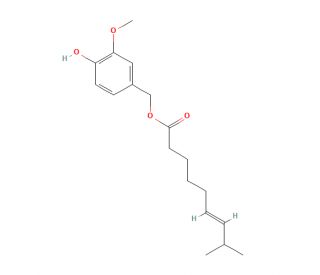

Capsiate (CAS 205687-01-0)
QUICK LINKS
Capsiate is a naturally occurring compound found in chili peppers, particularly in the non-pungent varieties such as the sweet pepper. It is structurally related to capsaicin, the component responsible for the heat in hot peppers, but lacks the typical pungency. In research applications, capsiate is studied for its potential to increase energy metabolism and fat oxidation, which is of interest in the field of nutrition science. Agricultural studies focus on the biosynthesis and genetic regulation of capsiate production in pepper plants, aiming to understand the mechanisms of capsaicinoid biosynthesis and to potentially enhance certain desirable traits in cultivated varieties. Additionally, capsiate is used in studies examining its potential as a natural food additive.
Capsiate (CAS 205687-01-0) References
- Capsiate, a nonpungent capsaicin analog, increases endurance swimming capacity of mice by stimulation of vanilloid receptors. | Haramizu, S., et al. 2006. Biosci Biotechnol Biochem. 70: 774-81. PMID: 16636441
- Capsiate, a nonpungent capsaicin-like compound, inhibits angiogenesis and vascular permeability via a direct inhibition of Src kinase activity. | Pyun, BJ., et al. 2008. Cancer Res. 68: 227-35. PMID: 18172315
- Capsiate inhibits ultraviolet B-induced skin inflammation by inhibiting Src family kinases and epidermal growth factor receptor signaling. | Lee, EJ., et al. 2010. Free Radic Biol Med. 48: 1133-43. PMID: 20123015
- Capsiate, a non-pungent capsaicin analog, reduces body fat without weight rebound like swimming exercise in mice. | Haramizu, S., et al. 2011. Biomed Res. 32: 279-84. PMID: 21878735
- One-procedure synthesis of capsiate from capsaicin by lipase-catalyzed dynamic transacylation. | Ishihara, K., et al. 2010. World J Microbiol Biotechnol. 26: 1337-40. PMID: 24026939
- Capsiate Inhibits DNFB-Induced Atopic Dermatitis in NC/Nga Mice through Mast Cell and CD4+ T-Cell Inactivation. | Lee, JH., et al. 2015. J Invest Dermatol. 135: 1977-1985. PMID: 25806854
- Improvement of Lipid and Glucose Metabolism by Capsiate in Palmitic Acid-Treated HepG2 Cells via Activation of the AMPK/SIRT1 Signaling Pathway. | Zang, Y., et al. 2018. J Agric Food Chem. 66: 6772-6781. PMID: 29886733
- Capsiate treatment in liver surgeries may compromise its recovery. | Barros, PP., et al. 2018. Acta Cir Bras. 33: 439-445. PMID: 29924209
- Effect of mild-intensity exercise training with capsiate intake on fat deposition and substrate utilization during exercise in diet-induced obese mice. | Hwang, D., et al. 2020. Phys Act Nutr. 24: 1-6. PMID: 33108711
- The gut microbiota metabolite capsiate promotes Gpx4 expression by activating TRPV1 to inhibit intestinal ischemia reperfusion-induced ferroptosis. | Deng, F., et al. 2021. Gut Microbes. 13: 1-21. PMID: 33779497
- Sweet pepper and its principle constituent capsiate: functional properties and health benefits. | Gupta, R., et al. 2022. Crit Rev Food Sci Nutr. 62: 7370-7394. PMID: 33951968
- Separation of nordihydrocapsiate from capsiate and major capsaicinoid analogues using ultra high performance liquid chromatography. | Biradar, K., et al. 2022. Food Chem. 382: 132585. PMID: 35247666
- Effects of Capsaicin and Capsiate on Endurance Performance: A Meta-Analysis. | Grgic, J., et al. 2022. Nutrients. 14: PMID: 36364793
Ordering Information
| Product Name | Catalog # | UNIT | Price | Qty | FAVORITES | |
Capsiate, 10 mg | sc-506004 | 10 mg | $370.00 |