
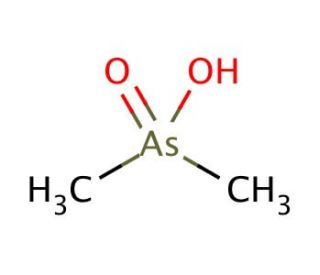

Molecular structure of Cacodylic acid, CAS Number: 75-60-5
Cacodylic acid (CAS 75-60-5)
Alternate Names:
Dimethylarsinic acid; Dimethylarsonic acid; Hydroxydimethylarsine oxide
Application:
Cacodylic acid is a useful arsinic acid for proteomics research
CAS Number:
75-60-5
Purity:
98%
Molecular Weight:
138.00
Molecular Formula:
C2H7AsO2
Supplemental Information:
This is classified as a Dangerous Good for transport and may be subject to additional shipping charges.
For Research Use Only. Not Intended for Diagnostic or Therapeutic Use.
* Refer to Certificate of Analysis for lot specific data.
QUICK LINKS
Ordering Information
Description
Technical Information
Safety Information
SDS & Certificate of Analysis
Cacodylic acid presents as a crystalline powder, varying from white to brown, and demonstrates solubility in water, alcohols, and acetic acid, but lacks solubility in ether. It is uses as an analytical reagent, it serves to inhibit polymerase chain reaction (PCR). Recognized as a mild arsenic acid, cacodylic acid can undergo exothermic oxidation when introduced to potent oxidizing agents and can be reduced by powerful reducing agents. Cacodylic acid is a useful arsinic acid for proteomics research.
Cacodylic acid (CAS 75-60-5) References
- A concise review of the toxicity and carcinogenicity of dimethylarsinic acid. | Kenyon, EM. and Hughes, MF. 2001. Toxicology. 160: 227-36. PMID: 11246143
- Possible role of dimethylarsinous acid in dimethylarsinic acid-induced urothelial toxicity and regeneration in the rat. | Cohen, SM., et al. 2002. Chem Res Toxicol. 15: 1150-7. PMID: 12230408
- Accurate nucleic acid concentrations by nuclear magnetic resonance. | Cavaluzzi, MJ., et al. 2002. Anal Biochem. 308: 373-80. PMID: 12419352
- Biological studies with arsenic; preparation of arsenic by pile irradiation of cacodylic acid. | STRAUBE, RL. and NEAL, WB. 1948. Proc Soc Exp Biol Med. 69: 270-2. PMID: 18102200
- Internal intensity standards for heme protein UV resonance Raman studies: excitation profiles of cacodylic acid and sodium selenate. | Song, SH. and Asher, SA. 1991. Biochemistry. 30: 1199-205. PMID: 1846749
- Optically detected magnetic resonance study of the interaction of an arsenic(III) derivative of cacodylic acid with EcoRI methyl transferase. | Tsao, DH. and Maki, AH. 1991. Biochemistry. 30: 4565-72. PMID: 2021649
- [Reducing cadmium content of rice grains by means of flooding and a few problems]. | Kawasaki, A., et al. 2012. Nihon Eiseigaku Zasshi. 67: 478-83. PMID: 23095358
- The acute inhalation toxicology of the technical grade organoarsenical herbicides, cacodylic acid and disodium methanearsonic acid; a route comparison. | Stevens, JT., et al. 1979. Bull Environ Contam Toxicol. 21: 304-11. PMID: 444720
- Tissue retention of arsenic in rats fed witch founder or cacodylic acid. | Siewicki, TC. 1981. J Nutr. 111: 602-9. PMID: 7218032
- The teratogenic potential of cacodylic acid in the rat and mouse. | Rogers, EH., et al. 1981. Drug Chem Toxicol. 4: 49-61. PMID: 7261946
- Cancer induction by an organic arsenic compound, dimethylarsinic acid (cacodylic acid), in F344/DuCrj rats after pretreatment with five carcinogens. | Yamamoto, S., et al. 1995. Cancer Res. 55: 1271-6. PMID: 7882321
- Disposition of 14C and/or 74As-cacodylic acid in rats after intravenous, intratracheal, or peroral administration. | Stevens, JT., et al. 1977. Environ Health Perspect. 19: 151-7. PMID: 908294
- Airborne contact dermatitis from cacodylic acid. | Bourrain, JL., et al. 1998. Contact Dermatitis. 38: 364-5. PMID: 9687061
- Embedding of laboratory wastes in clay or concrete blocks, with special reference to baking osmic acid and cacodylic acid wastes with clay. | Murakami, T., et al. 1998. Acta Med Okayama. 52: 297-303. PMID: 9876766
Inhibitor of:
GATA-1, HAPLN4, and SELENBP (selenium binding protein 1/2).Activator of:
RISC.Ordering Information
| Product Name | Catalog # | UNIT | Price | Qty | FAVORITES | |
Cacodylic acid, 5 g | sc-239453 | 5 g | $60.00 | |||
Cacodylic acid, 10 g | sc-239453A | 10 g | $103.00 | |||
Cacodylic acid, 25 g | sc-239453B | 25 g | $204.00 |