
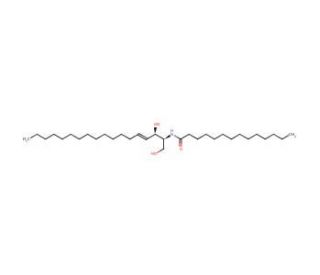

C14 Ceramide (CAS 34227-72-0)
QUICK LINKS
C14 Ceramide, with the CAS number 34227-72-0, is a synthetic analog of naturally occurring ceramides that features a tetradecanoic (myristic) acid linked to a sphingosine backbone. This configuration makes C14 Ceramide a simplified yet effective model compound for studying the role of ceramides in cellular functions. Ceramides are sphingolipids that play crucial roles in constructing cellular membranes and signaling pathways that dictate cell behavior such as proliferation, differentiation, and apoptosis. The C14 chain length in this particular ceramide makes it an ideal subject for research focused on the lipid bilayer′s properties, as it represents a mid-range length that can influence membrane fluidity and permeability. In research contexts, C14 Ceramide is employed to probe the mechanisms by which ceramides interact with other cell membrane components and how these interactions affect cellular signaling and function. Its use has been pivotal in studies related to lipid rafts and the formation of ceramide-enriched platforms that are thought to be critical in signal transduction and the initiation of programmed cell death. Additionally, C14 Ceramide serves as a tool to understand the metabolic pathways of ceramide synthesis and degradation, offering insights into the complex lipid networks that maintain cellular homeostasis and response to stress. Through studies involving C14 Ceramide, researchers gain a deeper understanding of the lipid-mediated regulatory mechanisms essential for cellular health and adaptation.
C14 Ceramide (CAS 34227-72-0) References
- Acyl chain length affects ceramide action on sterol/sphingomyelin-rich domains. | Nybond, S., et al. 2005. Biochim Biophys Acta. 1718: 61-6. PMID: 16321609
- Quantification of ceramide species in biological samples by liquid chromatography electrospray ionization tandem mass spectrometry. | Kasumov, T., et al. 2010. Anal Biochem. 401: 154-61. PMID: 20178771
- Analysis of glucocerebrosidase activity in dry blood spots using tandem mass spectrometry. | Legnini, E., et al. 2011. Clin Chim Acta. 412: 343-6. PMID: 21070755
- Ceramide synthases as potential targets for therapeutic intervention in human diseases. | Park, JW., et al. 2014. Biochim Biophys Acta. 1841: 671-81. PMID: 24021978
- The effect of altered sphingolipid acyl chain length on various disease models. | Park, WJ. and Park, JW. 2015. Biol Chem. 396: 693-705. PMID: 25720066
- Myristate-induced endoplasmic reticulum stress requires ceramide synthases 5/6 and generation of C14-ceramide in intestinal epithelial cells. | Choi, S., et al. 2018. FASEB J. 32: 5724-5736. PMID: 29768040
- Bioluminescent assay for sphingolipid ceramide N-deacylase using Vibrio harveyi dark mutant M-17 | Cho, Ki Woong. 2008. The Journal of Microbiology. 46: 585-589.
- Exogenous long chain C14 ceramide prevents insulin‐stimulated glucose uptake in C2C12 muscle cells independent of Akt signaling | Kelly K R, Hwang C, Kasumov T, et al. 2010. The FASEB Journal. 24: 783.5-783.5.
- Age-dependent changes in the sphingolipid composition of CD4+ T cell membranes and immune synapses | Huang Z, Marko M G, Bunnell S C, et al. 2010. The FASEB Journal. 24: 723.11-723.11.
Ordering Information
| Product Name | Catalog # | UNIT | Price | Qty | FAVORITES | |
C14 Ceramide, 5 mg | sc-210983 | 5 mg | $300.00 |