
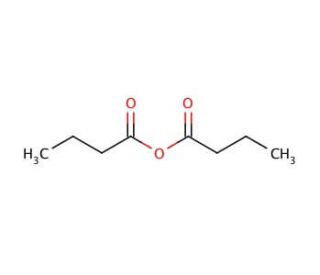

Butyric anhydride (CAS 106-31-0)
QUICK LINKS
Butyric anhydride, recognized by the CAS number 106-31-0, is a chemical compound that essentially functions as a reactive derivative of butyric acid, wherein two butyric acid molecules combine with the loss of water to form an anhydride. This compound is characterized by its strong, unpleasant odor and is primarily used in the synthesis of other chemicals, particularly esters and acyl chlorides, which are significant in various industrial applications. In organic synthesis, butyric anhydride serves as an acylating agent, offering a method to introduce butyryl groups into target molecules. This mechanism is central to studies in chemical synthesis where understanding the behavior of acyl groups is crucial. In research settings, butyric anhydride is utilized to modify the chemical structure of compounds, thereby altering their physical, chemical, and reactive properties for specific applications. For instance, it is used in the preparation of butyrate esters, which are important in the manufacture of flavors and fragrances. The compound′s role in producing these esters is pivotal for investigations into new scent and flavor profiles. Additionally, butyric anhydride is employed in materials science research, particularly in the modification of cellulose to create cellulose butyrate, a derivative used for its film-forming properties, enhancing the understanding of polymer behavior and applications.
Butyric anhydride (CAS 106-31-0) References
- Synthesis and hypoglycemic activity of esterified-derivatives of mangiferin. | Li, XJ., et al. 2013. Chin J Nat Med. 11: 296-301. PMID: 23725845
- Dibutyrylchitin nanoparticles as novel drug carrier. | Jain, T., et al. 2016. Int J Biol Macromol. 82: 1011-7. PMID: 26592700
- Pinosylvin-Based Polymers: Biodegradable Poly(Anhydride-Esters) for Extended Release of Antibacterial Pinosylvin. | Bien-Aime, S., et al. 2016. Macromol Biosci. 16: 978-83. PMID: 27071713
- Effects of Fatty Acid Anhydride on the Structure and Thermal Properties of Cellulose-g-Polyoxyethylene (2) Hexadecyl Ether. | Yu, W., et al. 2018. Polymers (Basel). 10: PMID: 30966532
- Effects of Acid-Anhydride-Modified Cellulose Nanofiber on Poly(Lactic Acid) Composite Films. | Jamaluddin, N., et al. 2021. Nanomaterials (Basel). 11: PMID: 33802905
- Peracetylation of polyphenols under rapid and mild reaction conditions. | de Alcântara Pinto, DC., et al. 2023. Nat Prod Res. 37: 2279-2284. PMID: 35073791
- Catalytic production and application of bio-renewable butyl butyrate as jet fuel blend- A review. | Kushwaha, N., et al. 2022. J Environ Manage. 310: 114772. PMID: 35228167
- Digestibility, structural and physicochemical properties of microcrystalline butyrylated pea starch with different degree of substitution. | Dong, F., et al. 2023. Carbohydr Polym. 314: 120927. PMID: 37173026
- Cellulose acylation in homogeneous and heterogeneous media: Optimization of reactions conditions. | Rodrigues, BVM., et al. 2023. Int J Biol Macromol. 243: 125256. PMID: 37295694
- Unraveling the gut health puzzle: exploring the mechanisms of butyrate and the potential of High-Amylose Maize Starch Butyrate (HAMSB) in alleviating colorectal disturbances. | Cheng, J. and Zhou, J. 2024. Front Nutr. 11: 1285169. PMID: 38304546
Ordering Information
| Product Name | Catalog # | UNIT | Price | Qty | FAVORITES | |
Butyric anhydride, 500 ml | sc-214641 | 500 ml | $50.00 | |||
Butyric anhydride, 1 L | sc-214641A | 1 L | $75.00 |