
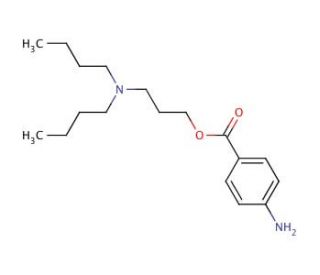

Molecular structure of Butacaine, CAS Number: 149-16-6
Butacaine (CAS 149-16-6)
Alternate Names:
3-(Dibutylamino)-1-propanol p-Aminobenzoate; 3-(p-Aminobenzoxy)-1-di-n-butylaminopropane
CAS Number:
149-16-6
Purity:
≥98%
Molecular Weight:
306.44
Molecular Formula:
C18H30N2O2
For Research Use Only. Not Intended for Diagnostic or Therapeutic Use.
* Refer to Certificate of Analysis for lot specific data.
QUICK LINKS
Ordering Information
Description
Technical Information
Safety Information
SDS & Certificate of Analysis
Butacaine is a compound that is primarily used in research to study the mechanisms and pathways of ester-type anesthetic agents. Its structure and action are of interest in comparative analyses with other local anesthetics, particularly in understanding the structure-activity relationship that governs the onset and duration of anesthesia. In membrane biophysics, butacaine is utilized to investigate the interaction between local anesthetics and cellular membranes, including the compound′s effect on membrane fluidity and ion channel function. Its role in affecting sodium channel kinetics is also a key research area, contributing to the broader understanding of nerve impulse propagation.
Butacaine (CAS 149-16-6) References
- Phospholipids as ionophores. | Tyson, CA., et al. 1976. J Biol Chem. 251: 1326-32. PMID: 1254569
- The effect of butacaine on adenine nucleotide binding and translocation in rat liver mitochondria. | Fayle, DR., et al. 1975. Biochem J. 148: 527-31. PMID: 128352
- The interaction between butacaine and rat liver mitochondria as shown by proton magnetic resonance spectroscopy. | Crompton, M., et al. 1976. Biochem Pharmacol. 25: 2461-4. PMID: 136258
- PAMPA - excipient classification gradient map. | Bendels, S., et al. 2006. Pharm Res. 23: 2525-35. PMID: 17053953
- Absorption-excipient-pH classification gradient maps: sparingly soluble drugs and the pH partition hypothesis. | Avdeef, A., et al. 2008. Eur J Pharm Sci. 33: 29-41. PMID: 17983735
- Estimation of matrix pH in isolated heart mitochondria using a fluorescent probe. | Jung, DW., et al. 1989. Anal Biochem. 178: 348-54. PMID: 2751096
- Energy-dependent contraction of swollen heart mitochondria--activation by butacaine. | Jung, DW. and Brierley, GP. 1979. Arch Biochem Biophys. 193: 76-87. PMID: 36855
- Comparison of the membrane-related effects of cytarabine and other agents on model membranes. | Koehler, KA., et al. 1985. Biochem Pharmacol. 34: 4025-31. PMID: 4062974
- Asymmetrical blockade of potassium exchange in muscle by SKF 525-A: comparison with butacaine. | Henderson, EG. and Volle, RL. 1974. J Pharmacol Exp Ther. 188: 553-63. PMID: 4273911
- Inhibition by local anaesthetics of adenine nucleotide translocation in rat liver mitochondria. | Spencer, TL. and Bygrave, FL. 1974. Biochem J. 140: 413-22. PMID: 4280910
- Studies on the mechanism of uncoupling by amine local anesthetics. Evidence for mitochondrial proton transport mediated by lipophilic ion pairs. | Garlid, KD. and Nakashima, RA. 1983. J Biol Chem. 258: 7974-80. PMID: 6223029
- [Effect of procaine, nicotinoylprocaine and butacaine on mammalian cells in culture]. | Müller, WH. and Freimüller, B. 1984. Arzneimittelforschung. 34: 1250-3. PMID: 6240271
- Cyclosporin and carnitine prevent the anoxic death of cultured hepatocytes by inhibiting the mitochondrial permeability transition. | Pastorino, JG., et al. 1993. J Biol Chem. 268: 13791-8. PMID: 8314748
- Mitochondrial permeability transition in the central nervous system: induction by calcium cycling-dependent and -independent pathways. | Kristal, BS. and Dubinsky, JM. 1997. J Neurochem. 69: 524-38. PMID: 9231710
- Epidermal iontophoresis: II. Application of the ionic mobility-pore model to the transport of local anesthetics. | Lai, PM. and Roberts, MS. 1998. Pharm Res. 15: 1579-88. PMID: 9794501
Ordering Information
| Product Name | Catalog # | UNIT | Price | Qty | FAVORITES | |
Butacaine, 1 g | sc-234227 | 1 g | $380.00 |