
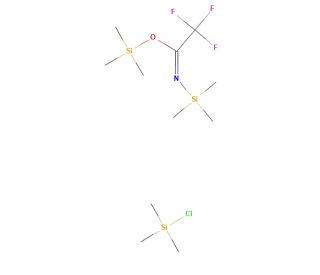

BSTFA-TMCS 的分子结构, CAS编号: 152571-61-4
BSTFA-TMCS (CAS 152571-61-4)
备用名:
N,O-bis(trimethylsilyl) Trifluoroacetamide Trimethylchlorosilane
CAS号码:
152571-61-4
分子量:
366.04
分子式:
C11H27F3NOSi3
补充资料:
此类物品属于危险品,运输时可能需要支付额外运费。
For Research Use Only. Not Intended for Diagnostic or Therapeutic Use.
* Refer to Certificate of Analysis for lot specific data.
快捷链接
订购信息
描述
技术信息
安全信息
安全技术说明书和分析证明书
Bstfa-tmcs (N,N-双(三甲基硅基)三氟乙酰胺-三甲基氯硅烷)是分析化学中广泛使用的硅基化试剂,用于气相色谱-质谱(GC-MS)样品制备。它是两种硅烷化剂的组合,即N,N-二(三甲基硅基)三氟乙酰胺(BSTFA)和三甲基氯硅烷(TMCS)。这种多功能试剂使伯胺和仲胺,硫醇和酚类的衍生化,促进其在各种应用中的表征。Bstfa-tmcs的应用跨越了不同的科学研究领域,特别是在药物发现和环境监测方面。它发现在分析不同的样品类型,包括生物样品,食品样品和环境样品的效用。通过与样品中存在的胺、硫醇和酚类反应,Bstfa-tmcs形成比原始化合物更易挥发的硅基衍生物。因此,这些衍生物可以很容易地用GC-MS检测。Bstfa-tmcs和TMCS与胺、硫醇和酚之间的反应涉及亲核取代反应。在这个过程中,亲核的TMCS攻击质子化胺、硫醇或苯酚,导致形成硅基衍生物。随后使用GC-MS检测这些衍生物有助于有效表征分析物,如氨基酸、肽、蛋白质和类固醇。
BSTFA-TMCS (CAS 152571-61-4) 参考文献
- 一名尸体包装工的可卡因中毒死亡病例。 | Furnari, C., et al. 2002. J Forensic Sci. 47: 208-10. PMID: 12064655
- 衍生试剂的选择--人体血液中胆固醇及其前体和植物甾醇的 GC-MS 分析。 | Saraiva, D., et al. 2011. J Chromatogr B Analyt Technol Biomed Life Sci. 879: 3806-11. PMID: 22088355
- 利用 GC-MS 对人体尿液中的新烟碱代谢物进行定量。 | Nomura, H., et al. 2013. J Chromatogr B Analyt Technol Biomed Life Sci. 941: 109-15. PMID: 24189204
- 利用气相色谱-质谱法测定生物样本中的烷基间苯二酚及其代谢物。 | Wierzbicka, R., et al. 2015. J Chromatogr B Analyt Technol Biomed Life Sci. 1000: 120-9. PMID: 26218771
- 优化植物提取物中五环三萜类化合物气相色谱-质谱分析前的衍生化方案。 | Jemmali, Z., et al. 2016. Talanta. 147: 35-43. PMID: 26592573
- 利用气相色谱和离子阱质谱法(GC-IT-MS)测定食品基质中游离固醇/氧基固醇的新方法。 | Szterk, A. and Pakuła, L. 2016. Talanta. 152: 54-75. PMID: 26992495
- 分析室内外空气微粒物质中二氢茉莉酸甲酯和半夏内酯的快速方法。 | Fontal, M., et al. 2016. J Chromatogr A. 1447: 135-40. PMID: 27113676
- 研究沿海城市空气颗粒物中的极性有机化合物。 | Balla, D., et al. 2018. Environ Sci Pollut Res Int. 25: 12191-12205. PMID: 28887799
- 利用实时质谱直接分析法(DART-MS)结合原位衍生法,快速定性分析医用药丸中的两种黄酮类化合物芦丁和水飞蓟宾。 | Nagy, T., et al. 2018. J Mass Spectrom. 53: 240-246. PMID: 29285822
- 对法医应用的土壤证据中的挥发性, 半挥发性和可挥发部分进行气相色谱-质谱定性分析:化学指纹识别 | Profumo, A., et al. 2020. Talanta. 219: 121304. PMID: 32887045
- 气相色谱-质谱法与随机森林算法相结合的大鼠膀胱癌尿液代谢组学研究 | Fang, M., et al. 2020. Int J Anal Chem. 2020: 8839215. PMID: 33014064
- 在疼痛治疗过程中使用阿片类药物。 | Goullé, JP., et al. 1997. Forensic Sci Int. 84: 137-44. PMID: 9042718
- 肉豆蔻苷在大鼠体内的体外和体内代谢。 | Lee, HS., et al. 1998. J Chromatogr B Biomed Sci Appl. 705: 367-72. PMID: 9521577
订购信息
| 产品名称 | 产品编号 | 规格 | 价格 | 数量 | 收藏夹 | |
BSTFA-TMCS, 1 g | sc-504322 | 1 g | $300.00 |