
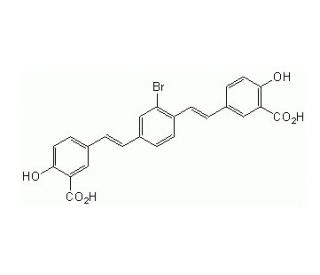

Molecular structure of BSB
BSB (CAS 291766-06-8)
Application:
BSB is a cell-permeable fluorescent probe used in Alzheimer′s research
CAS Number:
291766-06-8
Molecular Weight:
481.3
Molecular Formula:
C24H17BrO6
For Research Use Only. Not Intended for Diagnostic or Therapeutic Use.
* Refer to Certificate of Analysis for lot specific data.
QUICK LINKS
Ordering Information
Description
Technical Information
Safety Information
SDS & Certificate of Analysis
BSB is a cell-permeable fluorescent probe known for its ability to selectively bind and label intracellular amyloid-β aggregates. This characteristic makes it a valuable diagnostic tool for studying Alzheimer′s disease in animal models. BSB exhibits broad binding capabilities to various amyloid inclusions in their natural environment. By recognizing amyloid lesions, BSB possesses distinct properties that enable the quantitative monitoring of amyloid fibril formation. These fibrils are composed of Ab peptide, a-synuclein, and tau.
BSB (CAS 291766-06-8) References
- In vivo detection of amyloid plaques in a mouse model of Alzheimer's disease. | Skovronsky, DM., et al. 2000. Proc Natl Acad Sci U S A. 97: 7609-14. PMID: 10861023
- Radioiodinated styrylbenzene derivatives as potential SPECT imaging agents for amyloid plaque detection in Alzheimer's disease. | Kung, MP., et al. 2002. J Mol Neurosci. 19: 7-10. PMID: 12212796
- Detection of amyloid plaques by radioligands for Abeta40 and Abeta42: potential imaging agents in Alzheimer's patients. | Kung, MP., et al. 2003. J Mol Neurosci. 20: 15-24. PMID: 12663930
- Mechanism of A beta(1-40) fibril-induced fluorescence of (trans,trans)-1-bromo-2,5-bis(4-hydroxystyryl)benzene (K114). | LeVine, H. 2005. Biochemistry. 44: 15937-43. PMID: 16313197
- BSB: a new mouse model of multigenic obesity. | Fisler, JS., et al. 1993. Obes Res. 1: 271-80. PMID: 16353357
- Cyanine dye-protein interactions: looking for fluorescent probes for amyloid structures. | Volkova, KD., et al. 2007. J Biochem Biophys Methods. 70: 727-33. PMID: 17467807
- Congo red and thioflavin-T analogs detect Abeta oligomers. | Maezawa, I., et al. 2008. J Neurochem. 104: 457-68. PMID: 17953662
- Small molecule fluorescent probes for the detection of amyloid self-assembly in vitro and in vivo. | Bertoncini, CW. and Celej, MS. 2011. Curr Protein Pept Sci. 12: 205-20. PMID: 21348839
- K114 inhibits A-beta aggregation and inflammation in vitro and in vivo in AD/Tg mice. | Zhang, YH., et al. 2014. Curr Alzheimer Res. 11: 299-308. PMID: 24552157
- Electronic structure of BSb defective monolayers and nanoribbons. | Ersan, F., et al. 2014. J Phys Condens Matter. 26: 325303. PMID: 25049113
- Spectral photokinetic conversion of the fluorescent probes BSB and K114 for improved detection of amyloid assemblies. | Stepanchuk, AA., et al. 2021. J Biophotonics. 14: e202100203. PMID: 34499422
- Characterization of cell lines derived from enlarged spleens induced in C57BL/6 mice by the variant BSB strain of Friend erythroleukemia virus. | Geib, RW., et al. 1987. Virus Res. 8: 61-72. PMID: 3477906
- Dual-probe fluorescence spectroscopy for sensitive quantitation of Alzheimer's amyloid pathology. | Stepanchuk, AA., et al. 2022. Acta Neuropathol Commun. 10: 153. PMID: 36307888
Ordering Information
| Product Name | Catalog # | UNIT | Price | Qty | FAVORITES | |
BSB, 5 mg | sc-221384 | 5 mg | $275.00 |