
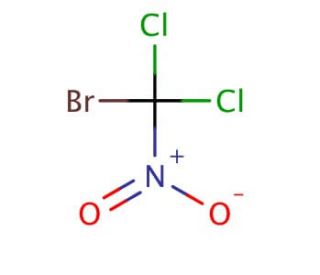

Molecular structure of Bromodichloronitromethane
Bromodichloronitromethane (CAS 918-01-4)
See product citations (1)
Alternate Names:
Dichlorobromonitromethane
Application:
Bromodichloronitromethane is an inducer of DNA strand breaks in mammalian cells
CAS Number:
918-01-4
Molecular Weight:
208.83
Molecular Formula:
CBrCl2NO2
Supplemental Information:
This is classified as a Dangerous Good for transport and may be subject to additional shipping charges.
For Research Use Only. Not Intended for Diagnostic or Therapeutic Use.
* Refer to Certificate of Analysis for lot specific data.
QUICK LINKS
Ordering Information
Product Citations
Description
Technical Information
Safety Information
SDS & Certificate of Analysis
Bromodichloronitromethane may act to interact with several biological molecules, including DNA, proteins, and lipids. It binds to DNA and proteins through hydrogen bonding and hydrophobic interactions. It also binds to lipids through hydrophobic interactions.
Bromodichloronitromethane (CAS 918-01-4) References
- Use of mechanism-based structure-activity relationships analysis in carcinogenic potential ranking for drinking water disinfection by-products. | Woo, YT., et al. 2002. Environ Health Perspect. 110 Suppl 1: 75-87. PMID: 11834465
- Hydrogen abstraction and decomposition of bromopicrin and other trihalogenated disinfection byproducts by GC/MS. | Chen, PH., et al. 2002. Environ Sci Technol. 36: 3362-71. PMID: 12188366
- Development of a research strategy for integrated technology-based toxicological and chemical evaluation of complex mixtures of drinking water disinfection byproducts. | Simmons, JE., et al. 2002. Environ Health Perspect. 110 Suppl 6: 1013-24. PMID: 12634133
- Halonitromethane drinking water disinfection byproducts: chemical characterization and mammalian cell cytotoxicity and genotoxicity. | Plewa, MJ., et al. 2004. Environ Sci Technol. 38: 62-8. PMID: 14740718
- Mutagenicity in Salmonella of halonitromethanes: a recently recognized class of disinfection by-products in drinking water. | Kundu, B., et al. 2004. Mutat Res. 562: 39-65. PMID: 15279829
- Kinetics and mechanisms of pH-dependent degradation of halonitromethanes by UV photolysis. | Fang, JY., et al. 2013. Water Res. 47: 1257-66. PMID: 23266387
- Highlighting the complexities of a groundwater pilot study during an avian influenza outbreak: Methods, lessons learned, and select contaminant results. | Hubbard, LE., et al. 2017. Environ Res. 158: 212-224. PMID: 28654877
- Formation of Iodinated Disinfection Byproducts (I-DBPs) in Drinking Water: Emerging Concerns and Current Issues. | Dong, H., et al. 2019. Acc Chem Res. 52: 896-905. PMID: 30919613
- Does Granular Activated Carbon with Chlorination Produce Safer Drinking Water? From Disinfection Byproducts and Total Organic Halogen to Calculated Toxicity. | Cuthbertson, AA., et al. 2019. Environ Sci Technol. 53: 5987-5999. PMID: 31038939
- GAC to BAC: Does it make chloraminated drinking water safer? | Cuthbertson, AA., et al. 2020. Water Res. 172: 115432. PMID: 32004911
- Controlling disinfection byproducts from treated wastewater using adsorption with granular activated carbon: Impact of pre-ozonation and pre-chlorination. | Verdugo, EM., et al. 2020. Water Res X. 9: 100068. PMID: 33015600
- Brominated trihalamines in chlorinated seawaters: Quantification of tribromamine and identification of bromochloramines by Membrane Introduction Mass Spectrometry. | Mensah, AT., et al. 2022. Sci Total Environ. 830: 154667. PMID: 35314219
- Exploring the impacts of service life of biological activated carbon on dissolved organic nitrogen removal. | Li, C., et al. 2023. Environ Pollut. 323: 121214. PMID: 36740163
Ordering Information
| Product Name | Catalog # | UNIT | Price | Qty | FAVORITES | |
Bromodichloronitromethane, 10 mg | sc-391878 | 10 mg | $374.00 |