
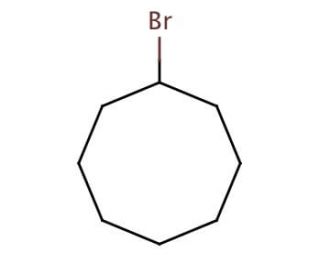

Molecular structure of Bromocyclooctane, CAS Number: 1556-09-8
Bromocyclooctane (CAS 1556-09-8)
Alternate Names:
Cyclooctyl bromide
Application:
Bromocyclooctane is Bromocyclooctane is a brominated cabocyclic compound with antibacterial and antineoplastic properties.
CAS Number:
1556-09-8
Molecular Weight:
191.11
Molecular Formula:
C8H15Br
For Research Use Only. Not Intended for Diagnostic or Therapeutic Use.
* Refer to Certificate of Analysis for lot specific data.
QUICK LINKS
Ordering Information
Description
Technical Information
Safety Information
SDS & Certificate of Analysis
Bromocyclooctane is a brominated cabocyclic compound with antibacterial and antineoplastic properties. Bromocyclooctane is a hydrocarbon containing both hydrogen and bromine atoms. Its versatility makes it valuable in scientific research applications, serving as a reagent in organic synthesis, a fuel additive, and a starting material for the synthesis of other compounds. The mechanism of action of Bromocyclooctane relies on its capacity to form covalent bonds with various molecules, including amino acids, peptides, and proteins.
Bromocyclooctane (CAS 1556-09-8) References
- Constrained bithiazoles: small molecule correctors of defective ΔF508-CFTR protein trafficking. | Coffman, KC., et al. 2014. J Med Chem. 57: 6729-38. PMID: 25061695
- Z-Selective Olefin Synthesis via Iron-Catalyzed Reductive Coupling of Alkyl Halides with Terminal Arylalkynes. | Cheung, CW., et al. 2015. J Am Chem Soc. 137: 4932-5. PMID: 25831473
- Regiodivergent C-H and Decarboxylative C-C Alkylation by Ruthenium Catalysis: ortho versus meta Position-Selectivity. | Korvorapun, K., et al. 2020. Angew Chem Int Ed Engl. 59: 18795-18803. PMID: 32700444
- Deaminative bromination, chlorination, and iodination of primary amines. | Xue, JH., et al. 2023. iScience. 26: 106255. PMID: 36909668
- Preparation, nuclear magnetic resonance study, and selective dehydrohalogenations of 1-bromo-2-trichloromethylcyclooctane | Traynham, J. G., & Couvillon, T. M. 1967. The Journal of Organic Chemistry. 32(3): 529-532.
- Deuterium-labeling experiments relevant to the mechanism of platinum-catalyzed hydrogenation of (diolefin) dialkylplatinum (II) complexes: evidence for isotopic exchange via platinum surface hydrogen. The stereochemistry of reduction | Miller, T. M., McCarthy, T. J., & Whitesides, G. M. 1988. Journal of the American Chemical Society. 110(10): 3156-3163.
- The Effect of Ring Size on Reactivity: The Diagnostic Value of 'Rate Profiles' | Masson, E., & Leroux, F. 2005. Helvetica chimica acta. 88(6): 1375-1386.
- Trifluoromethyl-Radical-Mediated Carbonylation of Alkanes Leading to Ethynyl Ketones | Uenoyama, Y., Fukuyama, T., Morimoto, K., Nobuta, O., Nagai, H., & Ryu, I. 2006. Helvetica chimica acta. 89(10): 2483-2494.
- Theoretical insight into electronic and molecular properties of halogenated (F, Cl, Br) and hetero-atom (N, O, S) doped cyclooctane | JA Agwupuye, H Louis, OC Enudi, TO Unimuke… - Materials Chemistry and …, 2022 - Elsevier. 1 January 2022,. Materials Chemistry and Physics. Volume 275,: 125239.
Ordering Information
| Product Name | Catalog # | UNIT | Price | Qty | FAVORITES | |
Bromocyclooctane, 5 g | sc-397360 | 5 g | $328.00 | |||
Bromocyclooctane, 25 g | sc-397360A | 25 g | $883.00 |