
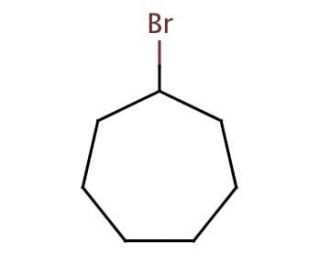

Bromocycloheptane (CAS 2404-35-5)
QUICK LINKS
Bromocycloheptane, a cyclic organic compound composed of a seven-membered carbon ring with a single bromine atom, belongs to the saturated hydrocarbon family, specifically the cycloalkane group. Known for its versatility, bromocycloheptane holds great potential across various domains, including organic synthesis, and chemical biology. Bromocycloheptane finds extensive utility in scientific research, serving as a valuable model compound for investigating the structure and reactivity of cycloalkanes, as well as understanding the mechanisms behind organic reactions. Notably, it has played a role in developing novel materials with distinctive physical and chemical properties, making it a valuable starting material for the synthesis of polymers and other such substances. At its core, bromocycloheptane′s unique properties stem from the bromine atom attached to the seven-membered carbon ring. This atom enables bromocycloheptane to act as a Lewis acid, capable of accepting electrons and forming covalent bonds with other molecules. Consequently, bromocycloheptane exhibits notable reactivity owing to the electron-accepting nature of the bromine atom, fostering the formation of covalent bonds with diverse molecular counterparts.
Bromocycloheptane (CAS 2404-35-5) References
- Iron-catalyzed cross-coupling of primary and secondary alkyl halides with aryl grignard reagents. | Nakamura, M., et al. 2004. J Am Chem Soc. 126: 3686-7. PMID: 15038701
- Conformational stability from variable temperature infrared spectra of krypton solutions, ab initio calculations, vibrational assignment, and r0 structural parameters of 1,3-difluoropropane. | Durig, JR., et al. 2004. Spectrochim Acta A Mol Biomol Spectrosc. 60: 1659-76. PMID: 15147712
- Iron-catalysed fluoroaromatic coupling reactions under catalytic modulation with 1,2-bis(diphenylphosphino)benzene. | Hatakeyama, T., et al. 2009. Chem Commun (Camb). 1216-8. PMID: 19240878
- The first iron-catalysed aluminium-variant Negishi coupling: critical effect of co-existing salts on the dynamic equilibrium of arylaluminium species and their reactivity. | Kawamura, S., et al. 2010. Chem Commun (Camb). 46: 6054-6. PMID: 20657915
- Nucleophilic reactions of bromocyclopentane in the structure-H methane + bromocyclopentane mixed hydrate system at high pressures. | Matsumoto, Y., et al. 2014. J Phys Chem B. 118: 13404-8. PMID: 25014739
- Rational Design of an Iron-Based Catalyst for Suzuki-Miyaura Cross-Couplings Involving Heteroaromatic Boronic Esters and Tertiary Alkyl Electrophiles. | Crockett, MP., et al. 2020. Angew Chem Int Ed Engl. 59: 5392-5397. PMID: 32022394
- A DFT Study on FeI/FeII/FeIII Mechanism of the Cross-Coupling between Haloalkane and Aryl Grignard Reagent Catalyzed by Iron-SciOPP Complexes. | Sharma, AK. and Nakamura, M. 2020. Molecules. 25: PMID: 32784472
- Ideal gas state thermodynamic functions for monohalogenated cyclo-alkanes | MJ Kelly, J Lielmezs - Thermochimica Acta, 1974 - Elsevier. September 1974,. Thermochimica Acta. Volume 10, Issue 1,: Pages 63-72.
- Silane reductions in acidic media. VII. Aluminum chloride catalyzed hydrogen-halogen exchange between organosilanes and alkyl halides. An efficient hydrocarbon synthesis | Michael P. Doyle, Charles C. McOsker, and Charles T. West. 1976. J. Org. Chem., 41, 8,: 1393–1396.
- Influence of mass transfer and chemical reaction on the kinetics of Grignard reagent formation for the example of the reaction of bromocyclopentane with a rotating disk of magnesium | Walter W. Hammerschmidt and Werner Richarz. 1991,. Ind. Eng. Chem. Res. 30, 1,: 82–88.
- Thermodynamic Stability Boundaries and Structures of Methane + Monohalogenated Cyclopentane Mixed Hydrates | Yuuki Matsumoto†, Hiroaki Matsukawa†, Fumitaka Kamo†, Young Bae Jeon†, Yoshito Katsuta†, Tatsuya Bando†, Takashi Makino‡, Takeshi Sugahara*†, and Kazunari Ohgaki†. 2014. J. Chem. Eng. Data., 59, 7,: 2294–2297.
- Molecular structure and pseudorotational motion of bromocyclopentane as determined by gas-phase electron diffraction☆ | C Bickford, Q Shen - Journal of Molecular Structure, 2001 - Elsevier. 13 June 2001,. Journal of Molecular Structure. Volumes 567–568,: Pages 269-274.
- The synthesis and binding properties of nano-scale hydrophobic pockets | CLD Gibb, H Xi, PA Politzer, M Concha, BC Gibb - Tetrahedron, 2002 - Elsevier. 21 January 2002,. Tetrahedron. Volume 58, Issue 4,: Pages 673-681.
Ordering Information
| Product Name | Catalog # | UNIT | Price | Qty | FAVORITES | |
Bromocycloheptane, 25 g | sc-234212 | 25 g | $104.00 |