
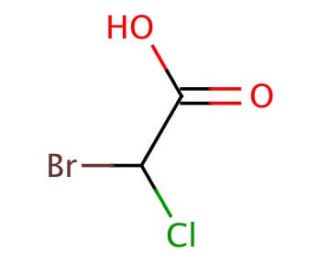

Molecular structure of Bromochloroacetic acid, CAS Number: 5589-96-8
Bromochloroacetic acid (CAS 5589-96-8)
Alternate Names:
2-bromo-2-chloroacetic acid
CAS Number:
5589-96-8
Molecular Weight:
173.39
Molecular Formula:
C2H2BrClO2
Supplemental Information:
This is as a Dangerous Good for transport and may be subject to additional shipping charges.
For Research Use Only. Not Intended for Diagnostic or Therapeutic Use.
* Refer to Certificate of Analysis for lot specific data.
QUICK LINKS
Ordering Information
Description
Technical Information
Safety Information
SDS & Certificate of Analysis
Bromochloroacetic acid is utilized in environmental chemistry, particularly in the analysis of water treatment processes where it serves as a byproduct indicator of disinfection methods. Studies frequently examine the formation mechanisms of Bromochloroacetic acid in chlorinated and brominated water to understand its impact on water quality and to improve filtration techniques. Bromochloroacetic acid′s role is investigated in the atmospheric chemistry, where it can participate in chemical reactions contributing to air pollution.
Bromochloroacetic acid (CAS 5589-96-8) References
- Bromochloroacetic acid exerts qualitative effects on rat sperm: implications for a novel biomarker. | Klinefelter, GR., et al. 2002. Toxicol Sci. 68: 164-73. PMID: 12075119
- Evaluation of the effects of water disinfection by-products, bromochloroacetic and dibromoacetic acids, on frog embryogenesis. | Weber, N., et al. 2004. J Toxicol Environ Health A. 67: 929-39. PMID: 15205036
- Haloacid induced alterations in fertility and the sperm biomarker SP22 in the rat are additive: validation of an ELISA. | Kaydos, EH., et al. 2004. Toxicol Sci. 81: 430-42. PMID: 15254336
- Analysis of the enantiomers of chiral pesticides and other pollutants in environmental samples by capillary electrophoresis. | Garrison, AW., et al. 2008. Methods Mol Biol. 384: 157-70. PMID: 18392570
- Toxicology and carcinogenesis studies of bromochloroacetic acid (CAS No. 5589-96-8) in F344/N rats and B6C3F1 mice (drinking water studies). | ,. 2009. Natl Toxicol Program Tech Rep Ser. 1-269. PMID: 19340096
- Mouse embryonic stem cell adherent cell differentiation and cytotoxicity (ACDC) assay. | Barrier, M., et al. 2011. Reprod Toxicol. 31: 383-91. PMID: 21296659
- The synergistic effect of sodium chlorite and bromochloroacetic acid on BrO3(-)-induced renal cell death. | Zhang, X., et al. 2011. Toxicology. 289: 151-9. PMID: 21864635
- Occurrence and health risk assessment of halogenated disinfection byproducts in indoor swimming pool water. | Hang, C., et al. 2016. Sci Total Environ. 543: 425-431. PMID: 26599142
- Complete dehalogenation of bromochloroacetic acid by liquid phase catalytic hydrogenation over Pd/CeO2 catalysts. | Zheng, C., et al. 2020. Chemosphere. 239: 124740. PMID: 31527005
- Formation of haloacetic acids from different organic precursors in swimming pool water during chlorination. | Wang, J., et al. 2020. Chemosphere. 247: 125793. PMID: 31931310
- Cancer Hazard Evaluations for Contemporary Needs: Highlights From New National Toxicology Program Evaluations and Methodological Advancements. | Lunn, RM., et al. 2022. J Natl Cancer Inst. 114: 1441-1448. PMID: 36029241
- Removal effect of trihalomethanes (THMs) and halogenated acetic acids (HAAs) precursors in reclaimed water by polyaluminum chloride (PACl) coagulation. | Wang, J., et al. 2023. Water Sci Technol. 87: 672-684. PMID: 36789711
Ordering Information
| Product Name | Catalog # | UNIT | Price | Qty | FAVORITES | |
Bromochloroacetic acid, 100 mg | sc-239417 | 100 mg | $84.00 |