
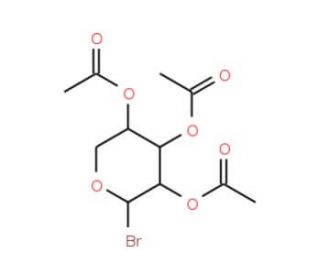

Bromo 2,3,4-Tri-O-acetyl-α-D-xylopyranoside (CAS 3068-31-3)
QUICK LINKS
Bromo 2,3,4-tri-O-acetyl-α-D-xylopyranoside, a derivative of xylose, has garnered attention in scientific research for its potential applications in carbohydrate chemistry and glycobiology. One of the primary areas of interest lies in the synthesis of glycoconjugates, where bromo 2,3,4-tri-O-acetyl-α-D-xylopyranoside serves as a versatile building block for the introduction of xylose residues into complex carbohydrate structures. This compound′s chemical properties, including its ability to selectively undergo glycosylation reactions at the anomeric position, make it valuable for the preparation of oligosaccharides and glycopeptides. Researchers have utilized bromo 2,3,4-tri-O-acetyl-α-D-xylopyranoside in the synthesis of various glycoconjugates for biological studies, including investigating the role of carbohydrates in molecular recognition processes, host-pathogen interactions, and immune responses. Moreover, this compound has been employed in the development of glycan microarrays, which enable high-throughput screening of carbohydrate-protein interactions and facilitate the elucidation of carbohydrate-mediated biological mechanisms. Additionally, bromo 2,3,4-tri-O-acetyl-α-D-xylopyranoside derivatives have been explored as potential probes for studying carbohydrate-processing enzymes and glycosyltransferases, providing insights into the enzymatic mechanisms involved in glycan biosynthesis and modification. Overall, bromo 2,3,4-tri-O-acetyl-α-D-xylopyranoside serves as a valuable tool in carbohydrate chemistry research, enabling the synthesis of diverse glycoconjugates and contributing to our understanding of carbohydrate-mediated biological processes.
Bromo 2,3,4-Tri-O-acetyl-α-D-xylopyranoside (CAS 3068-31-3) References
- Synthesis and antitumor activity of quaternary ellipticine glycosides, a series of novel and highly active antitumor agents. | Honda, T., et al. 1988. J Med Chem. 31: 1295-305. PMID: 3385725
Ordering Information
| Product Name | Catalog # | UNIT | Price | Qty | FAVORITES | |
Bromo 2,3,4-Tri-O-acetyl-α-D-xylopyranoside, 250 mg | sc-221381 | 250 mg | $330.00 |