
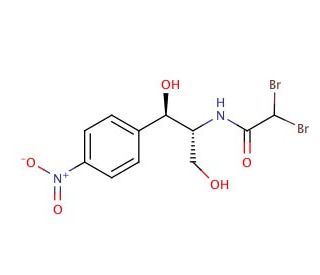

Bromamphenicol (CAS 16803-75-1)
LINK RAPIDI
Il bromamfenicolo, indicato con il numero CAS 16803-75-1, è un analogo bromurato del noto composto cloramfenicolo. Simile al suo composto di origine, il bromfenicolo funziona legandosi alla subunità 50S dei ribosomi batterici, ma presenta un atomo di bromo che sostituisce uno degli idrogeni nell'anello nitrobenzenico. Questa sottile modifica chimica influenza la sua interazione con il macchinario ribosomiale batterico. La modalità d'azione principale del bromamfenicolo consiste nell'inibizione dell'attività della peptidil transferasi, un processo enzimatico essenziale nella sintesi delle proteine. Interferendo con questo enzima, il bromamfenicolo blocca efficacemente la formazione di legami peptidici tra gli aminoacidi, inibendo così la sintesi proteica e bloccando la crescita batterica. Nella ricerca, il bromamfenicolo è stato utilizzato come strumento molecolare per studiare gli effetti dell'alogenazione sulla farmacodinamica degli antibiotici. Gli studi hanno esplorato il modo in cui tali modifiche influiscono sull'affinità di legame e sulla specificità di queste molecole nei confronti dei ribosomi batterici, contribuendo al più ampio campo della progettazione di antibiotici. La ricerca sul bromamfenicolo aiuta a comprendere le dinamiche strutturali e funzionali dell'inibizione ribosomiale, aprendo la strada allo sviluppo di nuovi antibiotici e al miglioramento di quelli esistenti per contrastare più efficacemente la resistenza batterica.
Bromamphenicol (CAS 16803-75-1) Referenze
- Studi sul meccanismo d'azione del cloramfenicolo. I. La conformazione del cloramfenicolo in soluzione. | JARDETZKY, O. 1963. J Biol Chem. 238: 2498-508. PMID: 13957484
- Studio strutturale dell'interazione tra l'emoagglutinina DraE e derivati del cloramfenicolo. | Pettigrew, DM., et al. 2009. Acta Crystallogr D Biol Crystallogr. 65: 513-22. PMID: 19465765
- Etichettatura di affinità del sito di legame della virginiamicina S sul ribosoma batterico. | Di Giambattista, M., et al. 1990. Biochemistry. 29: 9203-11. PMID: 2125475
- Mappatura dei componenti ribosomiali di Escherichia coli coinvolti nell'attività della peptidil transferasi. | Sonenberg, N., et al. 1973. Proc Natl Acad Sci U S A. 70: 1423-6. PMID: 4576018
- Alcune correlazioni tra proteine ribosomiali e attività ribosomiali. | Zamir, A., et al. 1974. Adv Exp Med Biol. 44: 123-39. PMID: 4837682
- Sul meccanismo d'azione del cloramfenicolo nella sintesi proteica. | Coutsogeorgopoulos, C. 1966. Biochim Biophys Acta. 129: 214-7. PMID: 5339107
- Analisi ai raggi X di alcune sostanze antibiotiche. | Dunitz, et al. 1950. Journal of the American Chemical Society. 72.9: 4276-4277.
- Struttura cristallina del cloramfenicolo1 e del bromamfenicolo2. | Dunitz and J. D. 1952. Journal of the American Chemical Society. 74.4: 995-999.
- [83] Analoghi del cloramfenicolo e loro applicazione alla marcatura dei ribosomi. | Sonenberg, et al. 1977. Methods in Enzymology. Vol. 46, Academic Press: 703-707.
- 1H, 13C MAS NMR e calcoli GIAO-CPHF di cloramfenicolo, tiamfenicolo e dei loro analoghi pirrolici. | Żołek and Teresa, et al. 2003. Journal of Molecular Structure. 646.1-3: 141-149.
Informazioni ordini
| Nome del prodotto | Codice del prodotto | UNITÀ | Prezzo | Quantità | Preferiti | |
Bromamphenicol, 5 mg | sc-391758 | 5 mg | $94.00 | |||
Bromamphenicol, 25 mg | sc-391758A | 25 mg | $328.00 |