
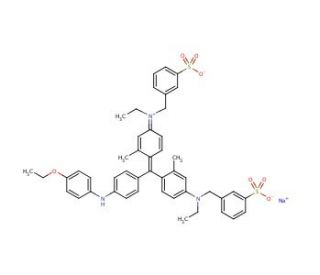

Brilliant Blue G (CAS 6104-58-1)
See product citations (11)
QUICK LINKS
Brilliant Blue G (CBBG) is a member of the Coomassie dye family and is commonly used in analytical biochemistry to stain proteins in SDS-PAGE and BN-PAGE. CBBG is a useful component in the Bradford Method, a dye-binding protein assay employed to determine protein concentration in a given solution. CBBG can exist in three forms: a cation (red form with maximum absorbance at 470 nm), a neutral form (green with maximum at 650 nm), and an anionic form (blue with maximum at 595 nm). The anionic form initiates a stable complex with basic amino acid residues, mainly arginine and aromatic amino acids. Although the anionic form exists in negligible concentrations at the assay reaction mixture's pH, the protein-binding shifts the equilibrium toward its formation. Recent research reveals CBBG as a P2X7 (P2X purinoceptor 7: P2RX7) antagonist and suggests that it exhibits neuroprotective properties in rat spinal cord cells.
Brilliant Blue G (CAS 6104-58-1) References
- Evaluation of Coomassie blue staining of the acrosome of equine and canine spermatozoa. | Brum, AM., et al. 2006. Am J Vet Res. 67: 358-62. PMID: 16454645
- A modified Coomassie Brilliant Blue staining method at nanogram sensitivity compatible with proteomic analysis. | Wang, X., et al. 2007. Biotechnol Lett. 29: 1599-603. PMID: 17563857
- Blue native electrophoresis for isolation of membrane protein complexes in enzymatically active form. | Schägger, H. and von Jagow, G. 1991. Anal Biochem. 199: 223-31. PMID: 1812789
- Systemic administration of an antagonist of the ATP-sensitive receptor P2X7 improves recovery after spinal cord injury. | Peng, W., et al. 2009. Proc Natl Acad Sci U S A. 106: 12489-93. PMID: 19666625
- Development and validation of an improved Bradford method for determination of insulin from chitosan nanoparticulate systems. | Su, ZQ., et al. 2010. Pharm Biol. 48: 966-73. PMID: 20731546
- Efficacy of inverted inner limiting membrane flap technique for macular holes of ≤400 μm: A systematic review and meta-analysis. | Lee, SM., et al. 2024. PLoS One. 19: e0302481. PMID: 38683767
- Moderate physical exercise and ATP modulate the P2X7 receptor and improve cisplatin-induced gastric emptying delay in rats. | Gomes, YA., et al. 2024. Braz J Med Biol Res. 57: e13234. PMID: 38716980
- Prediction of long-term visual outcome of idiopathic full-thickness macular hole surgery using optical coherence tomography parameters that estimate potential preoperative photoreceptor damage. | Bajdik, B., et al. 2024. Graefes Arch Clin Exp Ophthalmol.. PMID: 38717606
- Effect of vanadate on protein determination by the coomassie brilliant blue microassay procedure. | Matejovicova, M., et al. 1997. Anal Biochem. 245: 252-4. PMID: 9056222
- A rapid and sensitive method for the quantitation of microgram quantities of protein utilizing the principle of protein-dye binding. | Bradford, MM. 1976. Anal Biochem. 72: 248-54. PMID: 942051
Ordering Information
| Product Name | Catalog # | UNIT | Price | Qty | FAVORITES | |
Brilliant Blue G, 5 g | sc-203733 | 5 g | $39.00 | |||
Brilliant Blue G, 25 g | sc-203733A | 25 g | $99.00 |