
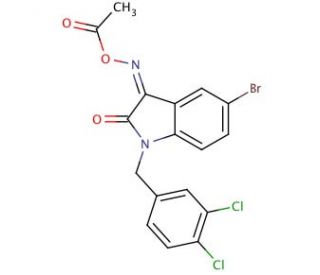

BML-282
QUICK LINKS
BML-282, a potent and selective inhibitor of the Krüppel-like factor 4 (KLF4) transcription factor, has garnered significant attention in scientific research due to its pivotal role in various cellular processes and disease pathogenesis. KLF4, a member of the Krüppel-like family of zinc finger transcription factors, regulates gene expression involved in cell differentiation, proliferation, and survival. BML-282 exerts its action by binding specifically to the zinc finger domain of KLF4, thereby disrupting its DNA-binding ability and transcriptional activity. This inhibition of KLF4 function has been investigated in diverse research areas, including cancer biology, stem cell research, and tissue engineering. In cancer studies, BML-282 has been utilized to explain the oncogenic functions of KLF4 and its contribution to tumor initiation, progression, and metastasis. Moreover, research has explored the potential of BML-282 in targeting KLF4-driven oncogenic pathways for the development of novel anti-cancer strategies. Furthermore, in stem cell research, BML-282 has been employed to modulate KLF4-mediated cellular reprogramming and differentiation processes, offering insights into the mechanisms underlying cell fate determination and pluripotency maintenance. Additionally, in tissue engineering applications, BML-282 has been investigated for its ability to regulate KLF4-mediated tissue regeneration and repair mechanisms, suggesting its potential utility in regenerative medicine approaches.
BML-282 References
- Mechanisms, biology and inhibitors of deubiquitinating enzymes. | Love, KR., et al. 2007. Nat Chem Biol. 3: 697-705. PMID: 17948018
- Ubiquitin C-terminal hydrolase-L1 (UCH-L1) as a therapeutic and diagnostic target in neurodegeneration, neurotrauma and neuro-injuries. | Wang, KK., et al. 2017. Expert Opin Ther Targets. 21: 627-638. PMID: 28434268
Ordering Information
| Product Name | Catalog # | UNIT | Price | Qty | FAVORITES | |
BML-282, 5 mg | sc-397015 | 5 mg | $111.00 |