
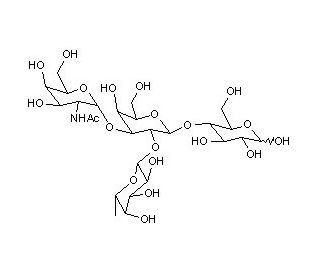

Blood Group A Tetrasaccharide (CAS 59957-92-5)
Voir les citations produits (1)
ACCÈS RAPIDE AUX LIENS
Le tétrasaccharide du groupe sanguin A, un antigène tétrasaccharidique présent à la surface des globules rouges des personnes du groupe sanguin A, a suscité une grande attention dans la recherche scientifique en raison de son rôle dans l'antigénicité du groupe sanguin et dans les processus de reconnaissance des hydrates de carbone. Cette structure tétrasaccharidique se compose de quatre unités de sucre, à savoir la N-acétyl-D-galactosamine, le D-galactose, le L-fucose et la N-acétyl-D-glucosamine, disposées selon une configuration spécifique. Les chercheurs ont largement étudié les interactions du tétrasaccharide du groupe sanguin A avec les protéines liant les glucides, telles que les lectines et les anticorps, afin d'élucider la base moléculaire de la reconnaissance des antigènes du groupe sanguin et des réponses immunitaires. En outre, ce tétrasaccharide a été utilisé comme système modèle dans les études de glycobiologie pour étudier les interactions glucides-protéines, les voies de biosynthèse des glycanes et les modifications enzymatiques impliquées dans l'expression des antigènes des groupes sanguins. En élucidant les déterminants structurels et les schémas de reconnaissance moléculaire du tétrasaccharide du groupe sanguin A, les chercheurs visent à approfondir notre compréhension des processus de reconnaissance immunitaire, de l'adhésion cellulaire médiée par les glycanes et des événements de signalisation. En outre, les connaissances acquises grâce à l'étude de cet antigène tétrasaccharidique contribuent au développement de nouveaux outils de diagnostic, de stratégies de glyco-ingénierie et d'interventions ciblant les processus biologiques médiés par les glucides. Grâce à des collaborations interdisciplinaires et à des techniques analytiques de pointe, les chercheurs continuent à élucider les rôles complexes du tétrasaccharide du groupe sanguin A dans la santé et la maladie, faisant ainsi progresser la glycobiologie et la recherche biomédicale.
Blood Group A Tetrasaccharide (CAS 59957-92-5) Références
- Études conformationnelles des oligosaccharides des groupes sanguins A et B à l'aide des couplages dipolaires résiduels de la RMN. | Azurmendi, HF. and Bush, CA. 2002. Carbohydr Res. 337: 905-15. PMID: 12007473
- Deux nouveaux décaglycosylcéramides avec une répétition de tétrasaccharides actifs sur le groupe sanguin A dans les cellules épithéliales de l'intestin grêle de rats consanguins. | Bouhours, D., et al. 1992. J Biol Chem. 267: 18533-40. PMID: 1526990
- Reconnaissance de l'antigène du groupe sanguin par un facteur de virulence de Streptococcus pneumoniae. | Boraston, AB., et al. 2006. J Biol Chem. 281: 35263-71. PMID: 16987809
- Simulation de la dynamique moléculaire des groupes sanguins de Lewis et des oligosaccharides apparentés. | Mukhopadhyay, C. and Bush, CA. 1991. Biopolymers. 31: 1737-46. PMID: 1793812
- Synthèse chimioenzymatique d'un tétrasaccharide du groupe sanguin A de type 2 et mise au point d'essais à haut débit permettant de créer une plate-forme pour le criblage des enzymes de libération des antigènes du groupe sanguin. | Kwan, DH., et al. 2015. Glycobiology. 25: 806-11. PMID: 25964111
- Caractérisation structurale du domaine C-terminal de la galectine-4 humaine: élucider la base moléculaire de la reconnaissance des glycosphingolipides, des saccharides sulfatés et des antigènes de groupe sanguin. | Bum-Erdene, K., et al. 2015. FEBS J. 282: 3348-67. PMID: 26077389
- Transformation du groupe sanguin O→A par ligature chimique des érythrocytes. | Ryzhov, IM., et al. 2019. Chembiochem. 20: 131-133. PMID: 30019804
- Détermination de la structure des oligosaccharides des groupes sanguins à partir de spectres 1H-n.m.r. entièrement assignés pour des solutions dans des solvants non aqueux. | Rao, BN. and Bush, CA. 1988. Carbohydr Res. 180: 111-28. PMID: 3197039
- Le symbiote intestinal humain Ruminococcus gnavus montre une spécificité à l'égard de l'antigène du groupe sanguin A pendant la recherche de glycane de mucine: Implication pour la colonisation de niche dans le tractus gastro-intestinal. | Wu, H., et al. 2021. PLoS Biol. 19: e3001498. PMID: 34936658
- La spécificité adhésive de la lectine humaine soluble, IgE-binding protein, vis-à-vis des oligosaccharides liés aux lipides. La présence des monosaccharides des groupes sanguins A, B, B-like et H confère une activité de liaison aux squelettes des tétrasaccharides (lacto-N-tétraose et lacto-N-néotétraose). | Feizi, T., et al. 1994. Biochemistry. 33: 6342-9. PMID: 8193150
Informations pour la commande
| Nom du produit | Ref. Catalogue | COND. | Prix HT | QTÉ | Favoris | |
Blood Group A Tetrasaccharide, 250 µg | sc-285031 | 250 µg | $600.00 | |||
Blood Group A Tetrasaccharide, 500 µg | sc-285031A | 500 µg | $902.00 |