
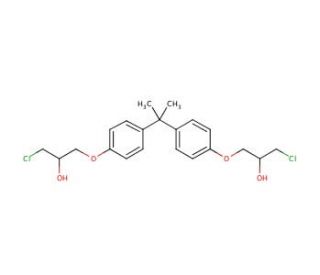

Bisphenol A bis(3-chloro-2-hydroxypropyl) ether (CAS 4809-35-2)
ACCÈS RAPIDE AUX LIENS
L'éther bis(3-chloro-2-hydroxypropyle) du bisphénol A (BPA-CPE) est un composé synthétique et polyéther comprenant deux molécules de bisphénol A (BPA) et un groupe 3-chloro-2-hydroxypropyle. La polyvalence de l'éther bis(3-chloro-2-hydroxypropyle) de bisphénol A est attestée par la diversité de ses propriétés, qui lui permettent de servir de surfactant, de plastifiant et de stabilisateur dans diverses applications. Dans la recherche scientifique, l'éther bis(3-chloro-2-hydroxypropyle) du bisphénol A a trouvé de nombreuses applications. En tant que surfactant, il aide à la synthèse de matériaux polymères en réduisant la tension superficielle des solutions de polymères, ce qui permet d'améliorer la dispersion du polymère. Son rôle de plastifiant lui permet de réduire la viscosité des solutions de polymères, ce qui améliore la dispersion du polymère. En outre, en tant que stabilisateur, il réduit efficacement le taux de dégradation du polymère, contribuant ainsi à une meilleure stabilité.
Bisphenol A bis(3-chloro-2-hydroxypropyl) ether (CAS 4809-35-2) Références
- Extraction assistée par micro-ondes pour la détermination simultanée des éthers glycidyliques de Novolac, de l'éther diglycidylique de bisphénol A et de ses dérivés dans les aliments en conserve en utilisant la CLHP avec détection par fluorescence. | Zhang, H., et al. 2010. J Sep Sci. 33: 235-43. PMID: 19950355
- Détermination simultanée des composés liés aux NOGE et aux BADGE dans les aliments en conserve par chromatographie liquide ultra-performante et spectrométrie de masse en tandem. | Zhang, H., et al. 2010. Anal Bioanal Chem. 398: 3165-74. PMID: 20953767
- Chromatographie liquide rapide et spectrométrie de masse en tandem pour l'analyse de l'éther diglycidylique du bisphénol A, de l'éther diglycidylique du bisphénol F et de leurs dérivés dans les aliments et les boissons en conserve. | Gallart-Ayala, H., et al. 2011. J Chromatogr A. 1218: 1603-10. PMID: 21333297
- Un nouveau cadre analytique pour l'analyse multi-résidus de perturbateurs endocriniens chimiquement divers dans des matrices environnementales complexes utilisant la chromatographie liquide ultra-performante couplée à la spectrométrie de masse quadripolaire en tandem à temps de vol à haute résolution. | Lopardo, L., et al. 2019. Anal Bioanal Chem. 411: 689-704. PMID: 30467767
- Stabilité de l'éther diglycidylique du bisphénol A, de l'éther diglycidylique du bisphénol F et de leurs dérivés dans des conditions contrôlées, analysées par chromatographie liquide couplée à la spectrométrie de masse en tandem. | Szczepańska, N., et al. 2019. Anal Bioanal Chem. 411: 6387-6398. PMID: 31321469
- Influence de la durée et de la température de stockage sur la toxicité, le potentiel endocrinien et la migration des précurseurs de résine époxy dans les extraits de matériaux d'emballage alimentaire. | Kudłak, B., et al. 2019. Molecules. 24: PMID: 31810163
- Criblage GC-MS pour l'identification des migrants potentiels présents dans les revêtements polymères des boîtes de conserve. | Lestido Cardama, A., et al. 2019. Polymers (Basel). 11: PMID: 31847163
- La lipidomique non ciblée révèle la toxicité du bisphénol A bis(3-chloro-2- hydroxypropyl) et des bisphénols A et F dans les cellules hépatiques du poisson zèbre. | Marqueño, A., et al. 2021. Ecotoxicol Environ Saf. 219: 112311. PMID: 33993092
- Application de Modèles In Vitro pour étudier les mécanismes Sous-jacents à l'Action Obésogène des Perturbateurs Endocriniens (PE) en tant que Contaminants alimentaires-Une revue. | Kowalczyk, M., et al. 2023. Int J Mol Sci. 24: PMID: 36674599
Informations pour la commande
| Nom du produit | Ref. Catalogue | COND. | Prix HT | QTÉ | Favoris | |
Bisphenol A bis(3-chloro-2-hydroxypropyl) ether, 250 mg | sc-252493 | 250 mg | $161.00 |