
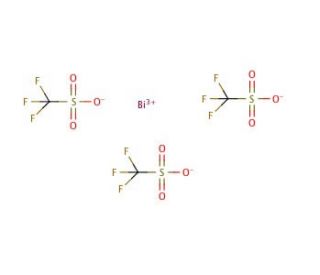

Bismuth(III) trifluoromethanesulfonate (CAS 88189-03-1)
Available in US only.
LINK RAPIDI
Il trifluorometansolfonato di bismuto(III), noto come BTFMS, si presenta come un solido cristallino bianco, solubile in acqua e in vari solventi organici. Questo versatile composto organosolforoso è ampiamente utilizzato come reagente nella sintesi organica grazie alle sue potenti capacità ossidanti. Inoltre, il trifluorometansolfonato di bismuto(III) trova applicazione nella chimica analitica e nella biochimica. Il trifluorometansolfonato di bismuto(III) svolge un ruolo fondamentale in una miriade di applicazioni della ricerca scientifica, che comprendono la sintesi inorganica e organica, la chimica analitica e la biochimica. Nel campo della sintesi organica, le sue potenti proprietà ossidanti facilitano l'ossidazione dei composti organici. Nell'ambito della chimica analitica, serve come prezioso reagente per la determinazione degli ioni metallici. Inoltre, in biochimica, il trifluorometansolfonato di bismuto(III) è utile per analizzare le catecolamine e altri composti biologici vitali. Come robusto agente ossidante, il trifluorometansolfonato di bismuto(III) opera attraverso un meccanismo di trasferimento di elettroni. Durante la reazione, gli elettroni vengono trasferiti dal composto organico alla molecola di Bismuto(III) trifluorometansolfonato, culminando nell'ossidazione del composto organico.
Bismuth(III) trifluoromethanesulfonate (CAS 88189-03-1) Referenze
- Sostituzione diretta catalizzata dal bismuto del gruppo idrossi negli alcoli con solfonammidi, carbammati e carbossammidi. | Qin, H., et al. 2007. Angew Chem Int Ed Engl. 46: 409-13. PMID: 17146812
- Formazione di oligo-addotti epossido-amminici come iniziatori funzionalizzati con OH per la polimerizzazione ad apertura anulare di ε-caprolattone. | Theis, J. and Ritter, H. 2010. Beilstein J Org Chem. 6: 938-44. PMID: 21085507
- Sintesi di trans-1,3-diaril-2-(5-metilisossazol-3-il)-2,3-diidro-1H-nafto[1,2-e][1,3]ossazine tramite reazione pseudo-quattro componenti one-pot catalizzata da bismuto(III). | Shafiee, M., et al. 2012. Mol Divers. 16: 727-35. PMID: 23090419
- Sintesi concisa del potenziale inibitore della COX BRL-37959 e degli analoghi che utilizzano l'acilazione Friedel-Crafts catalizzata dal bismuto(III). | Ahmed, SA., et al. 2018. Chem Biodivers. 15: e1800334. PMID: 30239128
- Valutazione di microarray a chimica click per l'immunosensing dell'alfa-fetoproteina (AFP). | Dadfar, SMM., et al. 2019. Beilstein J Nanotechnol. 10: 2505-2515. PMID: 31921529
- Polimeri funzionali e materiali polimerici da gamma-butirrolattoni alfa-insaturi rinnovabili. | Kollár, J., et al. 2019. Front Chem. 7: 845. PMID: 31921769
- Il triflato di bismuto(iii) come attivatore nuovo ed efficiente per gli alogenuri glicosilici. | Steber, HB., et al. 2021. Org Biomol Chem. 19: 3220-3233. PMID: 33885577
- Uso di un nuovo catalizzatore non tossico a base di bismuto per la preparazione di schiuma poliuretanica flessibile. | El Khezraji, S., et al. 2021. Polymers (Basel). 13: PMID: 34961011
- Rivestimenti intelligenti anticorrosione a base di poli(fenilene metilene): Valutazione del comportamento intrinseco di auto-guarigione del copolimero. | D'Elia, MF., et al. 2022. Polymers (Basel). 14: PMID: 36080534
- Recenti progressi nella chimica dei β-amminochetoni. | Hammouda, MM. and Elattar, KM. 2022. RSC Adv. 12: 24681-24712. PMID: 36128366
- Le piante utilizzano i biopolimeri di suberina come vettore per trasmettere la luce visibile attraverso le radici. | Waller, S., et al. 2022. Polymers (Basel). 14: PMID: 36559753
- Realizzazione di una membrana per dialisi a partire da di-acetato di cellulosa di cotone Giza 86, preparata utilizzando Ac2O e NiCl2 come nuovo catalizzatore. | Ragab, S., et al. 2023. Sci Rep. 13: 2276. PMID: 36755140
- Influenza dei gruppi alchilici periferici sulle configurazioni di giunzione nell'elettronica a molecola singola. | Ornago, L., et al. 2024. J Phys Chem C Nanomater Interfaces. 128: 1413-1422. PMID: 38293692
Informazioni ordini
| Nome del prodotto | Codice del prodotto | UNITÀ | Prezzo | Quantità | Preferiti | |
Bismuth(III) trifluoromethanesulfonate, 5 g | sc-257167 | 5 g | $56.00 | |||
| USA: Disponibile solo negli Stati Uniti | ||||||