
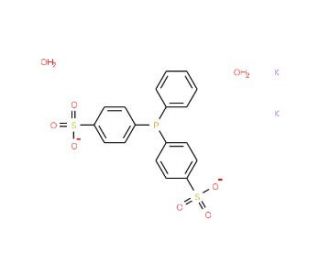

Bis(p-sulfonatophenyl)phenylphosphine dihydrate dipotassium salt (CAS 151888-20-9)
Direktverknüpfungen
Bis(p-sulfonatophenyl)phenylphosphin-Dihydrat-Dikalium-Salz dient als Ligand in der Koordinationschemie. Es wirkt als Stabilisator bei der Synthese von Metallkomplexen und erleichtert die Bildung von Koordinationsverbindungen durch seine Phosphingruppen. Der Wirkmechanismus von Bis(P-Sulfonatophenyl)phenylphosphin-Dihydrat-Dikaliumsalz besteht in der Bindung an Metallionen, wodurch die Bildung stabiler Koordinationskomplexe ermöglicht wird. Durch seine Phosphingruppen kann es sich effektiv mit Übergangsmetallen koordinieren und erleichtert so die Synthese von Metallkomplexen mit spezifischen Eigenschaften. Die funktionelle Rolle des Bis(P-Sulfonatophenyl)phenylphosphin-Dihydratsalzes liegt in seiner Fähigkeit, als Ligand an der Koordination von Metallionen mitzuwirken und die Eigenschaften der entstehenden Koordinationsverbindungen zu beeinflussen. Sein Wirkmechanismus besteht darin, dass es mit Metallionen interagiert und stabile Koordinationskomplexe bildet, wodurch es bei der Synthese von Materialien auf Metallbasis für verschiedene experimentelle Zwecke nützlich ist.
Bis(p-sulfonatophenyl)phenylphosphine dihydrate dipotassium salt (CAS 151888-20-9) Literaturhinweise
- Photomediierte Synthese von dreieckigen Bipyramiden und Prismen aus Silber: der Einfluss von pH-Wert und BSPP. | Zhang, J., et al. 2010. J Am Chem Soc. 132: 12502-10. PMID: 20718424
- Das Affinitätsverhältnis - seine zentrale Rolle in einem kompetitiven kolorimetrischen Aptasensor auf der Basis von Goldnanopartikeln. | Kim, YS., et al. 2011. Biosens Bioelectron. 26: 4058-63. PMID: 21514814
- Die Bis(p-sulfonatophenyl)phenylphosphin-unterstützte Synthese und der Phasentransfer von ultrafeinen Gold-Nanoclustern. | Zhong, J., et al. 2011. J Colloid Interface Sci. 361: 59-63. PMID: 21641611
- Plasmonenvermittelte Synthese von Silberwürfeln mit ungewöhnlichen Zwillingsstrukturen durch kurzwellige Anregung. | Personick, ML., et al. 2013. Small. 9: 1947-53. PMID: 23292747
- Schablonensynthese von hohlen Silberhexapoden unter Verwendung von hexapodenförmigen Silberoxidmesopartikeln. | Jo, J., et al. 2015. J Colloid Interface Sci. 448: 208-14. PMID: 25734223
- Biokompatible Gold-Nanostäbchen: Oberflächenfunktionalisierung in einem Schritt, hohe kolloidale Stabilität und geringe Zytotoxizität. | Liu, K., et al. 2015. Langmuir. 31: 4973-80. PMID: 25874503
- DNA-Biofunktionalisierung von CTAC-verkappten Goldnanowürfeln. | Slesiona, N., et al. 2020. Nanomaterials (Basel). 10: PMID: 32517070
- Einfacher kolorimetrischer Nachweis von Gadolinium-Ionen auf der Basis von Gold-Nanopartikeln: Schlüsselrolle von Phosphin-Sulfonat-Liganden. | Yon, M., et al. 2020. Nanoscale Adv. 2: 4671-4681. PMID: 36132884
- Gezielter Aufbau diskreter Gruppen von Goldnanopartikeln unter Verwendung verzweigter DNA-Gerüste | Claridge, S. A., Goh, S. L., Frechet, J. M., Williams, S. C., Micheel, C. M., & Alivisatos, A. P. 2005. Chemistry of materials. 17(7): 1628-1635.
- Eine Quarzkristall-Mikrowaagenstudie über die Adsorption von Fluorescein-5-Isothiocyanat an Goldoberflächen | Glomm, W. R., Bidegain, B. F., Volden, S., & Sjöblom, J. 2006. Journal of dispersion science and technology. 27(5): 651-656.
- Anklicken von DNA an Goldnanopartikel: Polyadenin-vermittelte Bildung von monovalenten DNA-Goldnanopartikel-Konjugaten mit nahezu quantitativer Ausbeute | Yao, G., Pei, H., Li, J., Zhao, Y., Zhu, D., Zhang, Y.,.. & Fan, C. 2015. NPG Asia materials. 7(1): e159-e159.
- Kolloidale Stabilität und Oberflächenchemie sind Schlüsselfaktoren für die Zusammensetzung der Proteinkorona von anorganischen Goldnanopartikeln | Johnston, B. D., Kreyling, W. G., Pfeiffer, C., Schäffler, M., Sarioglu, H., Ristig, S.,.. & Parak, W. J. 2017. Advanced Functional Materials. 27(42): 1701956.
- Elektronische Reaktionen auf Luftfeuchtigkeit in ein- und mehrschichtigen AuNP-Streifen, die durch konvektive Selbstmontage hergestellt wurden | Zhang, P., Dai, Y., Viktorova, J., Offenhäusser, A., & Mayer, D. 2018. physica status solidi (a). 215(15): 1700950.
Bestellinformation
| Produkt | Katalog # | EINHEIT | Preis | ANZAHL | Favoriten | |
Bis(p-sulfonatophenyl)phenylphosphine dihydrate dipotassium salt, 250 mg | sc-300239 | 250 mg | $84.00 |