
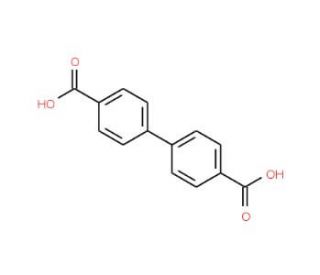

Biphenyl-4,4′-dicarboxylic acid (CAS 787-70-2)
QUICK LINKS
Biphenyl-4,4′-dicarboxylic acid is a compound that functions as a key intermediate in the synthesis of various organic compounds. Its mechanism of action involves participating in organic synthesis reactions, where it undergoes esterification, amidation, or condensation reactions to form more complex molecules. Biphenyl-4,4′-Dicarboxylic Acid plays a role in the development of advanced materials and chemical compounds due to its ability to undergo various chemical transformations. It serves as a versatile precursor for the creation of diverse chemical structures, contributing to the advancement of materials science and organic chemistry. Its molecular structure and reactivity make it a component in the synthesis of novel compounds with potential applications in various fields.
Biphenyl-4,4′-dicarboxylic acid (CAS 787-70-2) References
- Post synthetic exchange enables orthogonal click chemistry in a metal organic framework. | Fluch, U., et al. 2018. Dalton Trans. 48: 45-49. PMID: 30516766
- A Low-Temperature Approach for the Phase-Pure Synthesis of MIL-140 Structured Metal-Organic Frameworks. | Schulz, M., et al. 2019. Chemistry. 25: 13598-13608. PMID: 31397514
- Water Stable Zn(II) Metal-Organic Framework as a Selective and Sensitive Luminescent Probe for Fe(III) and Chromate Ions. | Rath, BB. and Vittal, JJ. 2020. Inorg Chem. 59: 8818-8826. PMID: 32501007
- Solvent-Induced Controllable Supramolecular Isomerism: Phase Transformation, CO2 Adsorption, and Fluorescence Sensing toward CrO42-, Cr2O72-, MnO4-, and Fe3. | Huang, YW., et al. 2020. Inorg Chem. 59: 9095-9107. PMID: 32559099
- Molecular magnetism in nanodomains of isoreticular MIL-88(Fe)-MOFs. | Dawood, S., et al. 2021. Phys Chem Chem Phys. 23: 21677-21689. PMID: 34581344
- High-performance lanthanum-based metal-organic framework with ligand tuning of the microstructures for removal of fluoride from water. | Yin, C., et al. 2022. J Colloid Interface Sci. 607: 1762-1775. PMID: 34600340
- The modulation effect of carboxylic acid ligands on the electron transfer photochromism of NDI-derived coordination polymers. | Li, GP., et al. 2021. Dalton Trans. 50: 15153-15161. PMID: 34617099
- Tetrathiafulvalene-Cobalt Metal-Organic Frameworks for Lithium-Ion Batteries with Superb Rate Capability. | Weng, YG., et al. 2021. Inorg Chem. 60: 17074-17082. PMID: 34702033
- Expanding structural diversity in a library of disulfide macrocycles through in-situ imide hydrolysis. | Konopka, M. and Stefankiewicz, AR. 2022. Sci Rep. 12: 38. PMID: 34997018
- A novel two-dimensional metal-organic framework as a recyclable heterogeneous catalyst for the dehydrogenative oxidation of alcohol and the N-arylation of azole compounds. | Liu, C., et al. 2021. RSC Adv. 11: 11739-11744. PMID: 35423643
- Enhanced photocatalytic activity of TiO2/UiO-67 under visible-light for aflatoxin B1 degradation. | Zhang, J., et al. 2022. RSC Adv. 12: 6676-6682. PMID: 35424625
- Exploring the Impact of the Linker Length on Heat Transport in Metal-Organic Frameworks. | Wieser, S., et al. 2022. Nanomaterials (Basel). 12: PMID: 35807978
- Expanding the Knowledge of the Selective-Sensing Mechanism of Nitro Compounds by Luminescent Terbium Metal-Organic Frameworks through Multiconfigurational ab Initio Calculations. | Hidalgo-Rosa, Y., et al. 2022. J Phys Chem A. 126: 7040-7050. PMID: 36154179
- Oxidatively Doped Tetrathiafulvalene-Based Metal-Organic Frameworks for High Specific Energy of Supercapatteries. | Ren, ZH., et al. 2023. ACS Appl Mater Interfaces. 15: 6621-6630. PMID: 36695585
- Ni- and Ni/Pd-Catalyzed Reductive Coupling of Lignin-Derived Aromatics to Access Biobased Plasticizers. | Su, ZM., et al. 2023. ACS Cent Sci. 9: 159-165. PMID: 36844489
Ordering Information
| Product Name | Catalog # | UNIT | Price | Qty | FAVORITES | |
Biphenyl-4,4′-dicarboxylic acid, 5 g | sc-239346 | 5 g | $119.00 | |||
Biphenyl-4,4′-dicarboxylic acid, 25 g | sc-239346A | 25 g | $413.00 |