
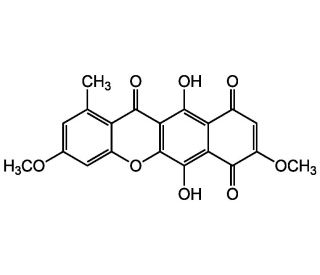

Bikaverin (CAS 33390-21-5)
See product citations (2)
QUICK LINKS
Bikaverin is a red pigment polyketide mycotoxin produced by various Fusarium species, particularly known for its role as a secondary metabolite with fungicidal and antibacterial properties. Its molecular mechanism involves the inhibition of mitochondrial respiration in competing microbial species, which is critical for understanding microbial interactions and the ecological dominance of Fusarium. The structure of bikaverin, characterized by its linear tetracyclic polyketide backbone, enables it to interfere with the electron transport chain, thereby reducing cellular energy production in target organisms. Research on bikaverin has expanded beyond its antimicrobial action to explore its potential as a natural dye and its role in the signaling pathways within Fusarium itself, impacting spore germination and virulence. Additionally, its production is often linked to environmental stress conditions, making bikaverin a valuable model for studying stress-induced metabolic pathways in fungi. Investigations into how bikaverin production is regulated by genetic and environmental factors also shed light on the broader regulatory networks controlling secondary metabolite biosynthesis in fungi. This research provides significant insights into microbial biochemistry and the potential exploitation of fungal secondary metabolites in various biotechnological applications.
Bikaverin (CAS 33390-21-5) References
- Bikaverin production by Fusarium species. | Chelkowski, J., et al. 1992. Mycotoxin Res. 8: 73-6. PMID: 23606002
- siRNA mediated gene silencing in Fusarium sp. HKF15 for overproduction of bikaverin. | Deshmukh, R. and Purohit, HJ. 2014. Bioresour Technol. 157: 368-71. PMID: 24636053
- Neuroprotective effects of bikaverin on H2O2-induced oxidative stress mediated neuronal damage in SH-SY5Y cell line. | Nirmaladevi, D., et al. 2014. Cell Mol Neurobiol. 34: 973-85. PMID: 24848007
- Production of bikaverin by a Fusarium fujikuroi mutant in submerged cultures. | Lale, GJ. and Gadre, RV. 2016. AMB Express. 6: 34. PMID: 27142994
- Pathway engineering in yeast for synthesizing the complex polyketide bikaverin. | Zhao, M., et al. 2020. Nat Commun. 11: 6197. PMID: 33273470
- Natural blue pigments and bikaverin. | Santos, MCD. and Bicas, JL. 2021. Microbiol Res. 244: 126653. PMID: 33302226
- Exploring Bikaverin as Metal Ion Biosensor: A Computational Approach. | Hussain, Z., et al. 2019. Acta Chim Slov. 66: 351-359. PMID: 33855498
- Expression of bik cluster and production of bikaverin by Fusarium oxysporum f. sp. lycopersici grown using two alternate nitrogen sources. | Rodríguez-Torres, MF., et al. 2022. Int Microbiol. 25: 153-164. PMID: 34455510
- Recovery and purification of bikaverin produced by Fusarium oxysporum CCT7620. | Mendonça, M., et al. 2021. Food Chem X. 12: 100136. PMID: 34661094
- Relation of shear stress and KLa on bikaverin production by Fusarium oxysporum CCT7620 in a bioreactor. | Dos Santos, MC., et al. 2022. Bioprocess Biosyst Eng. 45: 733-740. PMID: 35066678
Ordering Information
| Product Name | Catalog # | UNIT | Price | Qty | FAVORITES | |
Bikaverin, 1 mg | sc-391038 | 1 mg | $260.00 | |||
Bikaverin, 10 mg | sc-391038A | 10 mg | $2507.00 | |||
Bikaverin, 25 mg | sc-391038B | 25 mg | $5212.00 |